
TL;DR
Nvidia announced Rubin HPC on November 16, 2026, describing it as a GPU for scientific and engineering simulations and data processing, with more than 50,000 CUDA cores and seventh-generation NVLink. The company expects it in 2028, but has not disclosed performance benchmarks, memory specifications, power use or price.
Nvidia announced Rubin HPC at the SC26 supercomputing conference in Chicago on November 16, describing it as a GPU for scientific simulation and data processing rather than primarily for training and running AI models. Nvidia says the chip will have more than 50,000 CUDA cores and is expected to be available in 2028, but has not released independent performance results or key specifications such as memory, power use or price.

Get business pricing on tech for your team
- Business-only prices and quantity discounts
- Tax-exempt purchasing
- Multiple users, one account, clear invoices
The announcement appeared in a Nvidia blog post by Dan Ernst, senior director of supercomputing products. Nvidia says Rubin HPC is part of its Vera Rubin platform and is intended for science, engineering and analytics workflows. The company identifies climate modeling, engineering simulations, genomic analysis and financial risk as examples of workloads that can involve repeated calculations and large datasets.
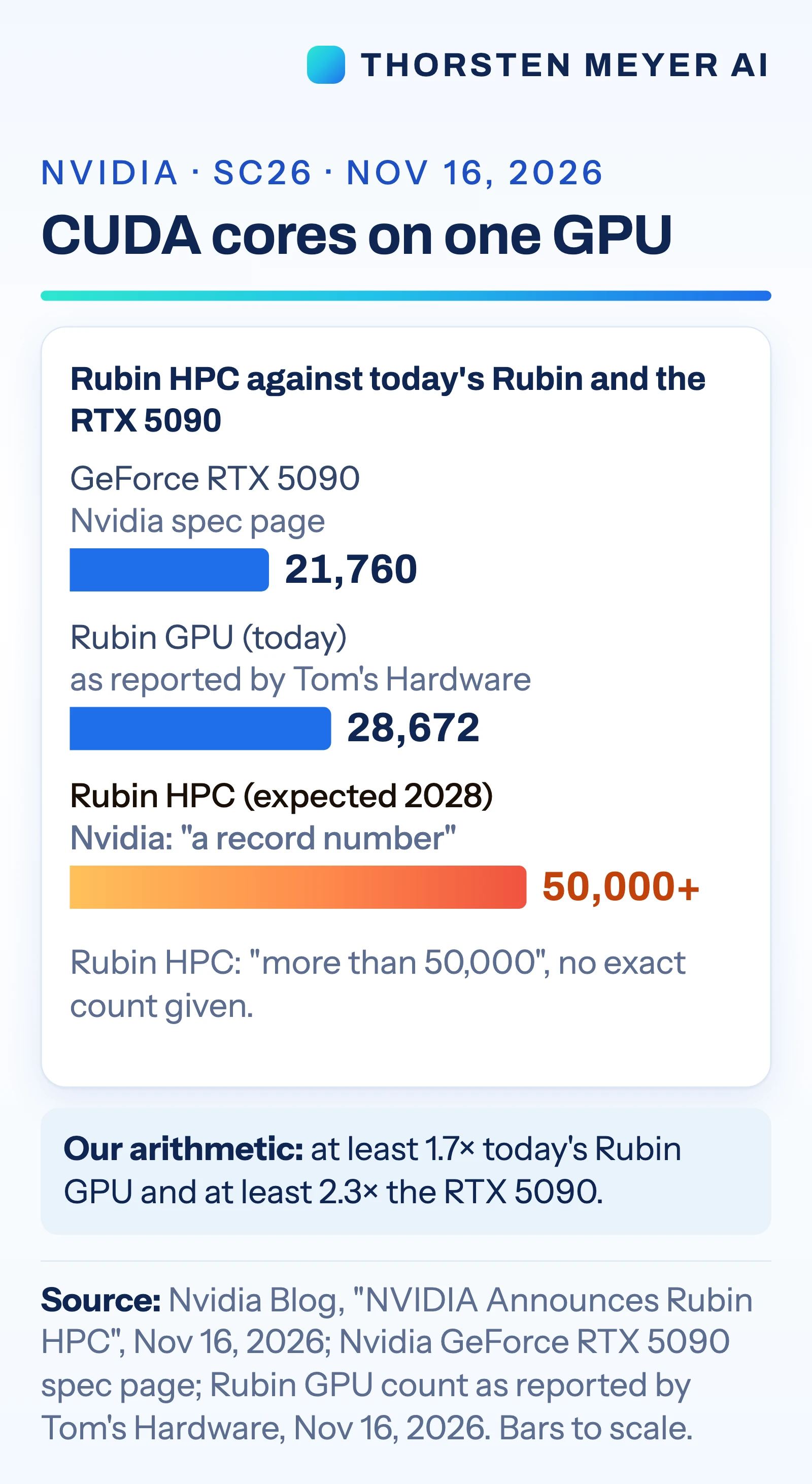
Nvidia’s headline specification is more than 50,000 CUDA cores on one GPU, a figure the company calls a record. It also says the GPU will have a sparse data acceleration capability to help supply data to its processing cores, and will connect to other GPUs using seventh-generation Nvidia NVLink. Nvidia has not described how the sparse-data feature works or published an exact core count.
For scale, the source material reports that today’s Rubin GPU has 28,672 CUDA cores, while Nvidia lists 21,760 for the GeForce RTX 5090. Those counts make Rubin HPC’s announced minimum at least 1.7 times the current Rubin figure and 2.3 times the RTX 5090 figure. These are comparisons of core counts, not measures of computing speed: performance depends on other specifications and the workload.
Why Simulation Speed Matters
Nvidia’s case for Rubin HPC rests on the role simulation can play between an idea and a physical test. Researchers and engineers can use computing to examine candidate materials, molecules or designs before committing to lab work or building a prototype. In Nvidia’s account, AI agents could propose candidates, while simulations test them and return results that inform the next round.
If the GPU can run relevant simulations faster, it could reduce the time needed to evaluate candidates and repeat that process. That prospect matters to research organizations and companies planning scientific computing capacity, particularly if they are linking AI systems to simulation software. But the announcement does not establish a speed advantage: core count alone cannot show how quickly a particular climate, engineering or molecular simulation would run, or what it would cost to operate.
The product also signals Nvidia’s effort to address computing beyond conventional AI model training and inference. Scientific applications can involve both intensive calculations and data access patterns that do not always keep processors busy. Nvidia says Rubin HPC’s design will scale data movement alongside compute; whether that approach produces gains for specific applications will require technical details and independent testing.
Products Worth Considering

Jackery HomePower 3000 Portable Power Station, 3072Wh

Samsung 32 Odyssey G5 QHD Gaming Monitor

Logitech MX Mechanical Wireless Illuminated Keyboard, Tactile Quiet, Graphite
As an affiliate, we earn on qualifying purchases.
Nvidia’s SC26 Chip Announcement
SC26, the supercomputing conference in Chicago, runs from November 15 to 20, 2026. Nvidia published its Rubin HPC announcement on November 16 as one of several company posts for the event. The source material reports no separate press release for Rubin HPC in Nvidia’s newsroom.
The new GPU is described as part of the Vera Rubin platform, which Nvidia already uses as the name for its broader computing platform. The source material says the current platform uses sixth-generation NVLink, while Rubin HPC is announced with seventh-generation NVLink. Nvidia has not provided enough detail to establish the chip’s physical layout. A suggestion that it could use a multi-die arrangement similar to a Rubin Ultra GPU is an outside inference reported by Tom’s Hardware, not a confirmed Nvidia specification.
The timing is also significant for planning: Nvidia says Rubin HPC is expected in 2028, rather than presenting it as an available product. Organizations weighing future systems will need more than the announced core count to compare it with existing accelerators or competing systems.
“Designed to accelerate simulation and data processing for science, engineering and analytics workflows.”
— Nvidia, in its November 16, 2026, blog announcement
Performance Data Still Missing
Nvidia has not published FP64 performance figures, memory capacity or bandwidth, power consumption, or a price for Rubin HPC. The announcement also provides no named systems or independent benchmarks. Without those details, buyers cannot judge the GPU’s performance per dollar or per watt, or compare its results on scientific workloads with other hardware.
The exact CUDA-core count and the implementation of sparse data acceleration remain undisclosed. The chip’s physical layout is also unclear; suggestions that it could use multiple dies are external speculation, not confirmed product information. Nvidia has not said which specific applications or simulation codes will be used to demonstrate the GPU, or when technical documentation and system configurations will be published.
Technical Details Due Before 2028
Nvidia’s stated milestone is Rubin HPC’s expected availability in 2028. Before then, researchers, system builders and potential buyers will need published specifications and details of the systems that will incorporate the GPU. Benchmarks on relevant scientific applications would help show whether the announced design translates into faster simulations and data processing.
Until Nvidia releases those details, the announcement establishes the chip’s intended market, a headline core-count threshold and its planned platform connections—not its real-world performance, cost or availability in specific systems. The next meaningful assessment will depend on technical disclosures and independent testing.
Key Questions
What is Nvidia Rubin HPC?
Rubin HPC is a GPU Nvidia announced for scientific and engineering simulation, data processing and analytics. Nvidia says it is part of the Vera Rubin platform.
How many CUDA cores will Rubin HPC have?
Nvidia says the GPU will have more than 50,000 CUDA cores, but it has not disclosed an exact count.
When is Rubin HPC expected to be available?
Nvidia says Rubin HPC is expected to be available in 2028. The company has not announced specific system configurations or a more precise release date in the supplied material.
Does the core count prove Rubin HPC will be faster?
No. Core counts alone do not establish application performance. Nvidia has not yet published independent benchmarks or key specifications such as memory bandwidth, power use and FP64 performance.
What does Nvidia say makes the GPU suited to science?
Nvidia points to its announced core count, a sparse data acceleration capability and seventh-generation NVLink. It says the design aims to scale data movement and compute together, but has not yet explained the sparse-data feature in detail.
Source: Thorsten Meyer AI