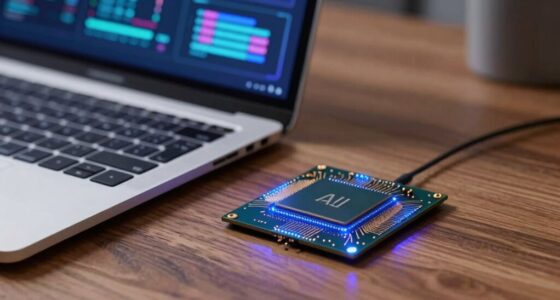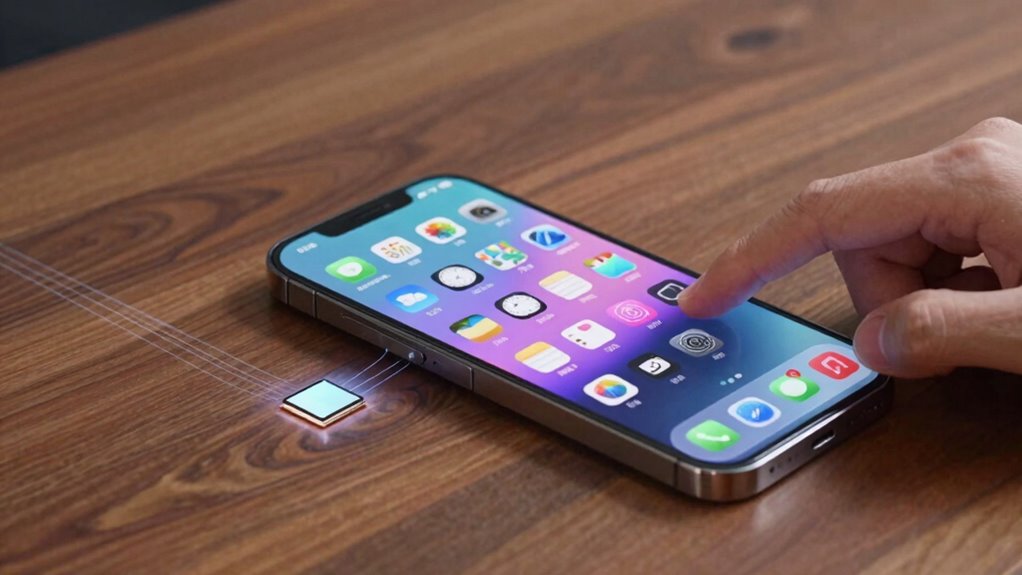
On-device AI means your apps can run faster, more privately, and reliably right on your device, without needing internet or cloud processing. It handles complex tasks like voice commands, image recognition, and recommendations locally, reducing lag and enhancing your experience. Plus, it keeps your sensitive data on your device, boosting security and privacy. It also conserves battery life and lets apps work offline. Keep exploring to discover how this technology is shaping your digital interactions even further.
Key Takeaways
- Enables faster responses and seamless interactions by processing data directly on your device.
- Enhances privacy by keeping sensitive data local and minimizing data transmission.
- Improves battery efficiency through reduced need for cloud communication.
- Allows apps to function offline, ensuring continuous usability without internet access.
- Drives smarter, more capable apps with improved responsiveness and security in the future.
With the rapid growth of AI technology, on-device AI has become a game-changer for app developers and users alike. Instead of relying on cloud servers to process data, on-device AI runs directly on your device, offering faster responses and more seamless experiences. This shift means your apps can handle complex tasks like voice recognition, image processing, and personalized recommendations right on your phone or tablet, without needing to send data to remote servers. As a result, you’ll notice quicker interactions, less lag, and smoother functionality, which enhances your overall user experience.
One of the biggest advantages of on-device AI is privacy enhancement. When your device processes data locally, sensitive information — like your voice commands, biometric data, or private photos — never leaves your device unless you choose to share it. This significantly reduces the risk of data breaches or unauthorized access that often accompany cloud-based processing. You gain peace of mind knowing that your personal information stays private and secure, since less data is transmitted over the internet. For apps that handle sensitive data, this local processing capability boosts user trust and aligns with increasing privacy regulations.
On-device AI enhances privacy by keeping sensitive data on your device, reducing risks of breaches and unauthorized access.
Battery efficiency is another critical benefit that on-device AI brings to everyday apps. Traditional cloud-based AI requires constant data transmission to and from servers, which can drain your device’s battery quickly. By processing data locally, on-device AI minimizes this back-and-forth, conserving energy and prolonging your device’s battery life. You can enjoy extended usage without worrying about rapid battery drain caused by intensive data uploads or downloads. Developers also optimize on-device AI models to be lightweight, further reducing power consumption while maintaining high performance. Additionally, energy-efficient models are being developed to maximize battery conservation even further. Furthermore, ongoing advancements in hardware capabilities are enabling more sophisticated AI processing directly on devices. As a result, the combination of hardware advancements and optimized models enables smarter, more capable on-device AI systems.
Moreover, on-device AI enables your apps to operate even without an internet connection. This means you can access voice assistants, translate languages, or use image recognition features anytime, anywhere. The independence from network connectivity makes your device more versatile and reliable, especially in areas with poor or unstable internet service. Additionally, this technology aligns with enterprise governance standards, ensuring that deployment remains secure and compliant with organizational policies.
In essence, on-device AI transforms how you interact with your apps daily. It offers faster, more responsive features while prioritizing your privacy and conserving battery life. As this technology continues to evolve, you’ll likely see even smarter, more efficient apps that adapt to your needs without compromising your security or draining your device. This shift not only improves your user experience but also pushes the boundaries of what your devices can do, making on-device AI an integral part of your digital life.
on-device AI voice assistant
As an affiliate, we earn on qualifying purchases.
As an affiliate, we earn on qualifying purchases.
Frequently Asked Questions
How Does On-Device AI Impact Battery Life in Apps?
On-device AI can improve battery life in apps because it uses local processing, reducing the need for constant data transfer to servers. This enhances battery optimization by lowering power consumption. You’ll notice your device consumes less energy since on-device AI handles tasks more efficiently, avoiding long data exchanges. As a result, your device stays powered longer, and apps run smoother without draining your battery quickly.
Can On-Device AI Improve App Privacy Beyond Data Encryption?
Yes, on-device AI can enhance your app privacy beyond data encryption. By processing data locally, it supports data sovereignty, meaning your sensitive information stays on your device, reducing risks of breaches. It also boosts user control, allowing you to decide what data to share and when. This approach minimizes reliance on cloud servers, giving you greater confidence that your personal info remains private and secure at all times.
What Hardware Is Necessary for Effective On-Device AI?
You need hardware optimized for processing power, like advanced chips or dedicated AI accelerators, to run on-device AI effectively. For example, smartphones with Apple’s Neural Engine or Google’s Tensor Processing Units (TPUs) handle complex AI tasks seamlessly. This hardware optimization guarantees quick responses and efficient energy use, making your apps smarter and more private without relying on cloud processing. Without such hardware, on-device AI would be slow or impractical.
How Does On-Device AI Affect App Update Frequency?
On-device AI can slow down app update frequency because developers focus on model optimization to guarantee models run smoothly locally. This means fewer updates are needed for model improvements, and apps may prioritize user personalization through real-time data processing instead of frequent updates. Consequently, your apps become more stable and tailored to your preferences, reducing the need for constant updates while enhancing your overall experience.
Are There Limitations to On-Device AI Capabilities?
Limitations linger in on-device AI, largely due to edge computing constraints and model optimization challenges. You might find that complex tasks bog down device performance or drain batteries faster. Smaller models improve speed but may sacrifice accuracy. While on-device AI offers privacy perks, it can’t yet match the vast processing power of cloud-based systems. So, you’re balancing between efficiency, accuracy, and resource restrictions when relying on on-device AI.
privacy-focused image recognition app
As an affiliate, we earn on qualifying purchases.
As an affiliate, we earn on qualifying purchases.
Conclusion
With on-device AI, you’re stepping into a future where apps are smarter, faster, and more private. You get instant responses without waiting for cloud processing, and your data stays safe right on your device. It’s like having a personal assistant that works behind the scenes, making your daily tasks smoother. Embrace these changes, because when it comes to innovation, you don’t want to be left in the dust. The tech world’s moving fast, and you’re right in the thick of it.
offline language translation device
As an affiliate, we earn on qualifying purchases.
As an affiliate, we earn on qualifying purchases.
battery-efficient AI smartphone
As an affiliate, we earn on qualifying purchases.
As an affiliate, we earn on qualifying purchases.