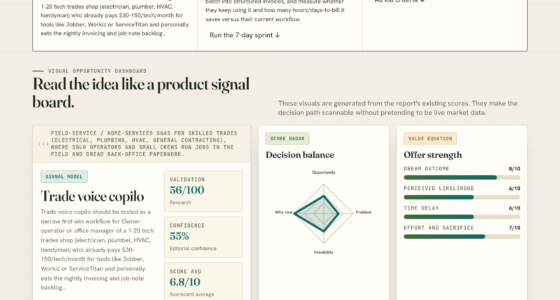

📊 Full opportunity report: When One Agent Isn’t Enough: Claude Now Builds Its Own Team Of Agents On The Fly on ThorstenMeyerAI.com — validation score, market gap, and execution plan.
TL;DR
Claude has launched a new feature called dynamic workflows, enabling it to create and orchestrate multiple specialized agents during a task. This development addresses limitations of single-agent operations in complex projects and signifies a step toward more autonomous AI management.
Claude, the AI model developed by Anthropic, has introduced a new capability allowing it to build and manage its own team of agents on the fly. This feature, called dynamic workflows, aims to improve performance on complex, high-value tasks by orchestrating multiple specialized subagents, addressing limitations of single-agent operation.
The new feature enables Claude to generate small JavaScript programs that spawn and coordinate multiple subagents, each with a focused goal and isolated context. This approach allows Claude to perform tasks more reliably by dividing work, avoiding common failure modes such as agent laziness, self-bias, and goal drift.
According to Anthropic, this capability is especially useful for complex workflows like deep research, fact-checking, and large-scale code refactoring, where a single agent might underperform or lose focus. The system can choose different models for different sub-tasks and resume interrupted workflows seamlessly.
While technically sophisticated, Anthropic emphasizes that this feature is intended for high-value, complex tasks, not simple or trivial requests. The company has also highlighted that the process involves more tokens and computational resources than traditional single-agent interactions.
When one agent isn’t enough: Claude now builds its own team on the fly
Skills package what you know; loops decide how far you delegate over time. Dynamic workflows are the third axis — within a single task, Claude writes its own harness and assembles a temporary team of subagents. Think of it as Claude drawing an org chart for one job.
The shift is from prompting a worker to commissioning a team — more output, more cost, and a manager’s judgment required. Reach for a workflow when a task is big, parallel, adversarial, or judgment-heavy — and when you can feel a single agent getting lazy, grading its own homework, or losing the plot. Bound it (token budgets, pilot first) — workflows can spawn hundreds of agents and burn far more tokens. For everything else, don’t hire five people to change a lightbulb.
Implications for AI Autonomy and Workflow Management
This development marks a significant step toward more autonomous AI systems capable of managing complex projects without human intervention. By enabling Claude to build and oversee its own team, organizations could see improvements in efficiency, accuracy, and reliability when deploying AI for research, analysis, or development tasks.
It also demonstrates a shift in how AI models are used: from passive tools to active orchestrators capable of self-organization. This could influence future AI design, pushing toward more modular, multi-agent architectures that mirror human team dynamics.

Agentic Artificial Intelligence: Harnessing AI Agents to Reinvent Business, Work and Life
As an affiliate, we earn on qualifying purchases.
As an affiliate, we earn on qualifying purchases.
Evolution of Multi-Agent Capabilities in AI
Anthropic’s recent work on Claude builds on prior developments in multi-agent systems, where multiple AI agents collaborate or compete to solve problems. The concept of dynamic workflows is the latest in a series of innovations aimed at overcoming the limitations of single-agent models, which often struggle with long, complex, or adversarial tasks.
Earlier iterations involved static workflows or hand-crafted orchestrations, but the new system allows Claude to generate tailored, task-specific harnesses automatically. This follows a broader industry trend toward more flexible, scalable AI architectures capable of handling real-world complexity.
While the technology is still emerging, it aligns with ongoing research into autonomous AI management and multi-agent collaboration, which aim to enhance reliability and scope of AI applications.
“Claude’s ability to autonomously generate and manage its own team of agents is a breakthrough in handling complex workflows, moving us closer to fully autonomous AI systems.”
— Thorsten Meyer, AI researcher at Anthropic

Claude Code & Cursor Mastery Handbook (2026): Build Autonomous AI Software Systems with Agentic Workflows, Multi-Agent Architectures, and Production-Ready Pipelines
As an affiliate, we earn on qualifying purchases.
As an affiliate, we earn on qualifying purchases.
Unanswered Questions About System Limitations
It is not yet clear how well this system performs in real-world, large-scale deployments, or how it handles unexpected errors during complex workflows. Details about the robustness, security, and potential failure modes of autonomous agent management are still emerging, and further testing is needed to establish reliability.

SQL for the AI Era: The Complete Handbook for Intelligent Data Systems, Machine Learning Readiness, and Real-World Automation (Foundations of Software and Data Systems in the AI Era)
As an affiliate, we earn on qualifying purchases.
As an affiliate, we earn on qualifying purchases.
Next Steps for Deployment and Evaluation
Anthropic plans to conduct broader testing and gather user feedback on dynamic workflows. Future updates may include refinements to the orchestration patterns, improved error handling, and expanded use cases. Monitoring how organizations adopt and adapt this technology will be key to understanding its long-term impact.

Project Management with AI For Dummies
As an affiliate, we earn on qualifying purchases.
As an affiliate, we earn on qualifying purchases.
Key Questions
How does Claude build its own team of agents?
Claude generates small JavaScript programs called workflows that spawn multiple subagents, each with a specific goal, and manages their coordination dynamically during a task.
What kinds of tasks benefit most from this feature?
High-complexity, high-value tasks such as deep research, fact-checking, large-scale code refactoring, and multi-step analysis are the primary beneficiaries of dynamic workflows.
Is this technology ready for production use?
While promising, Anthropic indicates that the feature is still in early deployment stages and is best suited for complex, resource-intensive tasks rather than simple interactions.
Does this increase operational costs?
Yes, because it involves more tokens and computational resources, making it more suitable for tasks where the benefits outweigh the increased costs.
Could this lead to fully autonomous AI systems?
This development is a step toward greater autonomy, but further research and testing are needed before such systems are widely adopted in critical applications.
Source: ThorstenMeyerAI.com