TL;DR
Muse has announced Glimmer, a 30-billion-parameter AI model designed for always-on local agent tasks. This development aims to improve on-device AI performance with optimized efficiency. Details about deployment and performance remain emerging.
Muse has introduced Glimmer, a 30-billion-parameter AI model specifically optimized for always-on local agent workflows. This development aims to enable more efficient, persistent AI applications directly on user devices, reducing reliance on cloud infrastructure and enhancing privacy.
Muse’s Glimmer is a large language model (LLM) with 30 billion parameters, designed to operate continuously on local hardware. According to Muse, the model is optimized for low latency and energy efficiency, making it suitable for integration into devices such as smartphones, embedded systems, and edge computing units. The company claims that Glimmer maintains high performance for tasks like real-time assistance, automation, and contextual understanding without requiring constant cloud connectivity. This aligns with trends in local AI system development.While Muse has not disclosed detailed technical specifications or benchmarks, they emphasize that Glimmer is tailored for persistent, always-on workflows, a feature increasingly demanded by industries seeking to enhance privacy and reduce latency. Discover more about local AI innovations. The company also states that the model can be fine-tuned for specific applications, further improving its utility in various domains.
Impact of Glimmer on On-Device AI Capabilities
The launch of Glimmer signifies a step forward in local AI deployment, reducing dependence on cloud services and potentially improving privacy and security for users. As AI models grow larger, optimizing them for always-on, low-power operation becomes critical for widespread adoption in consumer and industrial devices. This development could accelerate the integration of advanced AI functionalities into everyday hardware, making AI assistance more seamless, private, and responsive.
As an affiliate, we earn on qualifying purchases.
Positioning of Glimmer in the AI Hardware Ecosystem
Prior to Glimmer, most large language models required significant cloud infrastructure, limiting their use in privacy-sensitive or latency-critical applications. Recent trends have focused on edge AI and on-device models, with companies like Apple, Google, and Meta developing smaller or more efficient models. Muse’s announcement aligns with this shift, emphasizing models optimized for persistent local operation.
In 2023, several companies have announced efforts to create models suitable for edge deployment, but few have publicly detailed models of this scale explicitly designed for always-on workflows. Muse’s Glimmer appears to be a notable addition to this emerging category, although technical benchmarks and adoption timelines are still to be clarified.
“Glimmer is designed to deliver high performance in continuous, on-device workflows while maintaining energy efficiency and low latency.”
— Muse spokesperson
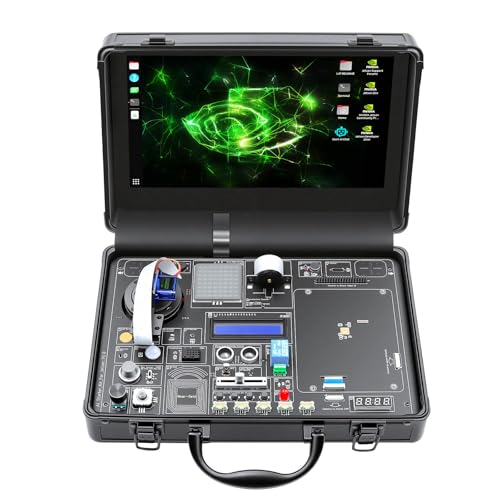
ELECROW AI Starter Kit for Jetson Orin Nano, 30 Sensors No Soldering Board, 8MP IMX219 Gimbal Camera, 11.6" IPS Screen, 38 Python Tutorials with AI Voice Interaction (Without Jetson Orin Nano Board)
- No-Solder Sensor Board: 30 integrated sensors for easy setup
- Includes Accessories: 128G SD card, adapter, mounting plates
- 8MP Gimbal Camera: Supports face and target tracking
As an affiliate, we earn on qualifying purchases.
As an affiliate, we earn on qualifying purchases.
Unanswered Questions About Glimmer’s Performance and Adoption
Specific technical benchmarks, such as accuracy, latency, and energy consumption metrics, have not yet been publicly disclosed. It remains unclear how Glimmer compares to existing models in real-world applications or when it will be widely available for integration into devices.
Additionally, details about the hardware requirements for optimal performance and the scope of industry partnerships are still emerging, leaving some uncertainty about the model’s immediate adoption and scalability.
As an affiliate, we earn on qualifying purchases.
Next Steps for Glimmer Deployment and Evaluation
Muse is expected to release more detailed technical documentation and benchmarks in the coming months. Industry partners and developers will likely begin testing Glimmer in various applications, which will clarify its practical performance and integration challenges.
Further announcements might include collaborations with hardware manufacturers or pilot programs in specific sectors such as automotive, IoT, or mobile devices, indicating the model’s broader deployment trajectory.

Local LLM Inference Optimization: A Comprehensive Guide to Quantization, Hardware Acceleration, and Efficient Private AI Deployment
As an affiliate, we earn on qualifying purchases.
As an affiliate, we earn on qualifying purchases.
Key Questions
What makes Glimmer different from other AI models?
Glimmer is specifically optimized for always-on, local workflows, focusing on low latency and energy efficiency, unlike many large models designed primarily for cloud-based operation.
Will Glimmer work on consumer devices?
While Muse has not confirmed specific hardware requirements, the model’s design aims for deployment on edge devices such as smartphones and embedded systems, pending further technical disclosures.
When will Glimmer be available for developers?
Details about the release timeline are not yet confirmed. Muse plans to share more technical details and access programs in the upcoming months.
How does Glimmer improve privacy?
By enabling on-device processing, Glimmer reduces the need to transmit sensitive data to cloud servers, enhancing user privacy and data security.
What industries could benefit most from Glimmer?
Industries such as automotive, IoT, consumer electronics, and industrial automation could leverage Glimmer for real-time, private AI applications.
Source: hn