![GPT-5.6 Sol Ultra Produces Proof Of The Cycle Double Cover Conjecture [Pdf]](https://aismasher.com/wp-content/uploads/2026/07/gpt-5-6-sol-ultra-produces-proof-of-the-cycle-double-cover-conjecture-pdf-featured-200x110.jpg "GPT-5.6 Sol Ultra Produces Proof Of The Cycle Double Cover Conjecture [Pdf] 2")
The real debate over AI and creative ownership questions who holds rights when AI generates art, music, or inventions. You must consider whether AI should be seen as a tool or an autonomous creator, and how current laws address this shift. Key issues include who claims authorship—the user, the developer, or AI itself—and ethical concerns about originality. As technology advances, laws are evolving, and understanding these changes will help you grasp the future of creative rights.
Open a free Amazon Business account
Business pricing, bulk buying and tax-exempt orders.
As an affiliate, we earn on qualifying purchases.
Key Takeaways
- The core debate centers on whether AI can be considered an autonomous creator deserving of ownership rights.
- Legal systems struggle to classify AI-generated works and determine rightful ownership between users and developers.
- Ethical questions arise about AI’s originality and the value of human effort in creative processes.
- Evolving regulations aim to redefine authorship, ownership, and intellectual property in the context of AI creation.
- Society must reconsider traditional notions of creativity and authorship as AI increasingly contributes to artistic and innovative works.

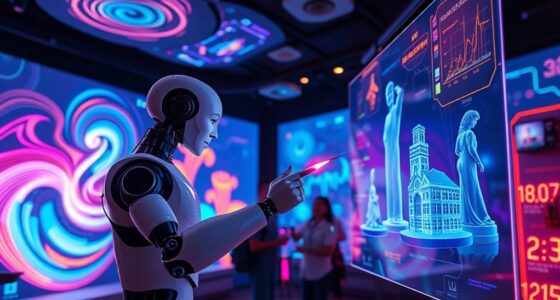
As artificial intelligence continues to advance, the debate over creative ownership has become more urgent and complex. You might wonder who holds the rights to works generated by AI—whether it’s the programmer, the user, or the machine itself. This question strikes at the core of intellectual property laws and authorship rights, which were originally designed for human creators. But now, with AI producing art, music, writing, and even inventions, those traditional concepts are being challenged. You need to contemplate whether AI should be viewed as a tool, like a camera or a pen, or as an autonomous creator that deserves recognition and ownership.
When it comes to intellectual property, the lines get blurry. Typically, copyright laws grant creators the rights to their original works, but what happens when a piece is generated by an AI algorithm trained on countless datasets? If you use an AI tool to generate a song or a design, you might think you’re the author, but legal frameworks often struggle to classify such works. Does the person who inputted the prompts hold authorship rights? Or does the AI’s developer retain ownership because they created the underlying system? These questions are central to the debate, and current laws haven’t kept pace with the technology. As a creator, you might worry about losing control over your work or about potential disputes over who truly owns an AI-generated piece.
You also need to consider the ethical implications. If AI can produce creative works independently, it raises questions about originality and the value of human effort. Should AI-generated art be protected under copyright at all? Some argue that since AI lacks consciousness and intent, it shouldn’t hold authorship rights. Others believe that the person who trained the AI or curated its outputs should claim ownership. The debate often circles back to the idea of authorship rights—who gets credit, who benefits financially, and how to fairly attribute creative contributions. As you navigate this landscape, it’s clear that the existing legal framework may need significant revisions to accommodate the unique nature of AI-produced content. Additionally, the evolving legal landscape surrounding AI-generated works indicates that lawmakers are only beginning to recognize the complexities involved. Moreover, understanding AI technology and how it influences creative processes is essential for shaping future policies. Recognizing the rapid development of AI-generated content can also help anticipate future legal and ethical challenges, ensuring that legislation keeps pace with technological innovation. It’s equally important to consider the regulatory environment, which is continually adapting to address these emerging issues. Ultimately, the real debate over AI and creative ownership isn’t just about legal definitions; it’s about redefining what it means to be a creator in an era where machines can generate works once thought exclusive to humans. You’re at the forefront of a shift that could reshape intellectual property laws and authorship rights, forcing society to reconsider the value of human creativity versus machine output.
As an affiliate, we earn on qualifying purchases.
Frequently Asked Questions
How Does Ai-Generated Work Impact Traditional Copyright Laws?
AI-generated work challenges traditional copyright laws by introducing legal ambiguities around authorship and ownership. You might find it difficult to determine who holds rights—the AI creator or the user. Ethical considerations also come into play, as questions about originality and fair compensation arise. These complexities require updates to existing laws, ensuring they address AI’s role in creativity and protect both human and machine contributions effectively.
Who Owns Ai-Created Content—The Developer or the User?
You might think the developer owns AI-created content, but in reality, ownership depends on the extent of creative collaboration. AI ethics suggest that users who actively guide and shape the output often hold more rights. When you leverage AI as a tool to enhance your ideas, you’re engaging in a partnership. Consequently, the true owner is usually the person who directs and refines the creative process, not just the developer behind the tech.
Can AI Truly Possess Creative Intent or Originality?
AI cannot truly possess creative intent or originality because it lacks artificial consciousness and true creative autonomy. While it can generate innovative content based on patterns and data, it doesn’t have personal experiences or subjective awareness driving its outputs. You might see AI as a tool that mimics creativity, but without genuine consciousness, it doesn’t truly originate ideas or possess intentionality behind its creations.
How Are Intellectual Property Rights Enforced for Ai-Produced Art?
You’ll find that intellectual property rights for AI-produced art are enforced through existing legal frameworks, although these are still evolving to address new challenges. Courts often consider ethical considerations, such as authorship and originality, when determining rights. You should stay informed about jurisdiction-specific laws, as they influence how AI creations are protected. Ultimately, clear legal guidelines are essential to guarantee creators and developers can confidently protect their AI-generated works.
Will AI Diminish Human Roles in Creative Industries?
AI might reduce some human roles in creative industries, but it also emphasizes the importance of human collaboration. You’ll find that AI bias can influence outputs, making your input essential to guide and refine. Instead of replacing humans, AI tools can empower you to focus on more complex, creative aspects, ensuring your unique perspective remains indispensable. Embracing this shift allows for innovative collaborations that enhance artistic expression.
As an affiliate, we earn on qualifying purchases.
Conclusion
As you navigate the AI and creative ownership debate, remember that this issue is still evolving, and there are no clear-cut answers yet. While AI can be a powerful tool, it also challenges traditional notions of originality and rights. Stay informed, ask questions, and don’t be afraid to voice your perspective. After all, it’s better to be safe than sorry—sometimes you have to call a spade a spade to get to the root of the matter.
As an affiliate, we earn on qualifying purchases.
intellectual property legal books
As an affiliate, we earn on qualifying purchases.
As an affiliate, we earn on qualifying purchases.
NFL season / tailgating Picks
team gear
As an affiliate, we earn on qualifying purchases.