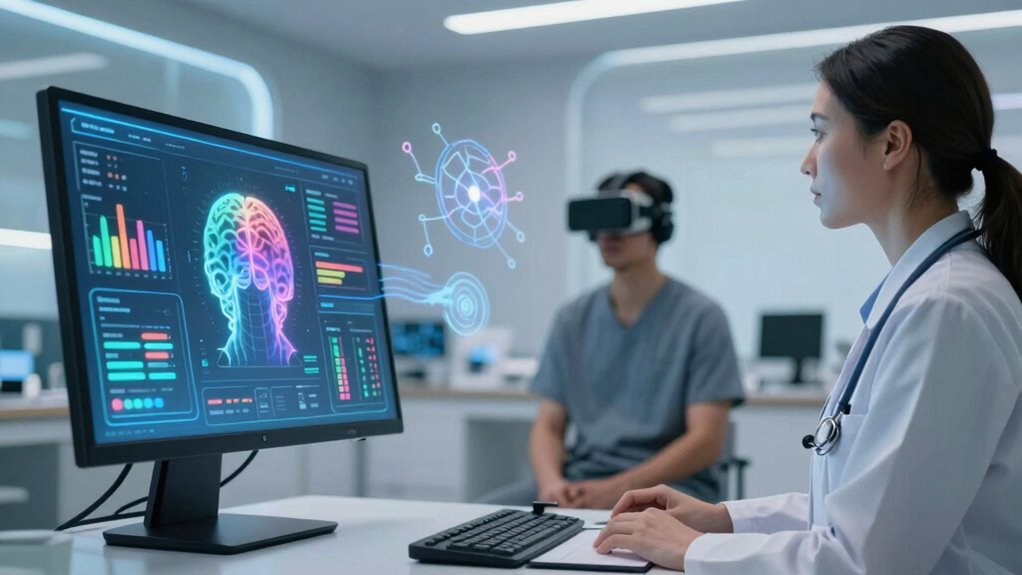

AI can considerably improve mental health screening by offering faster, more accurate assessments that are accessible to diverse populations. It can analyze large data sets, like speech and facial expressions, to detect early signs of issues and enable earlier intervention. However, challenges like data bias and privacy concerns must be addressed to guarantee fair and ethical use. If you keep exploring, you’ll discover how these hurdles can be overcome to create more equitable mental health support.
Key Takeaways
- AI enables faster, more accurate mental health assessments across large populations.
- It increases accessibility for diverse and underserved communities.
- AI analyzes multiple data types, such as speech and facial expressions, for early detection.
- Responsible AI deployment requires addressing bias, ensuring data privacy, and promoting ethical practices.
- Continuous evaluation and inclusive design improve fairness and effectiveness at scale.
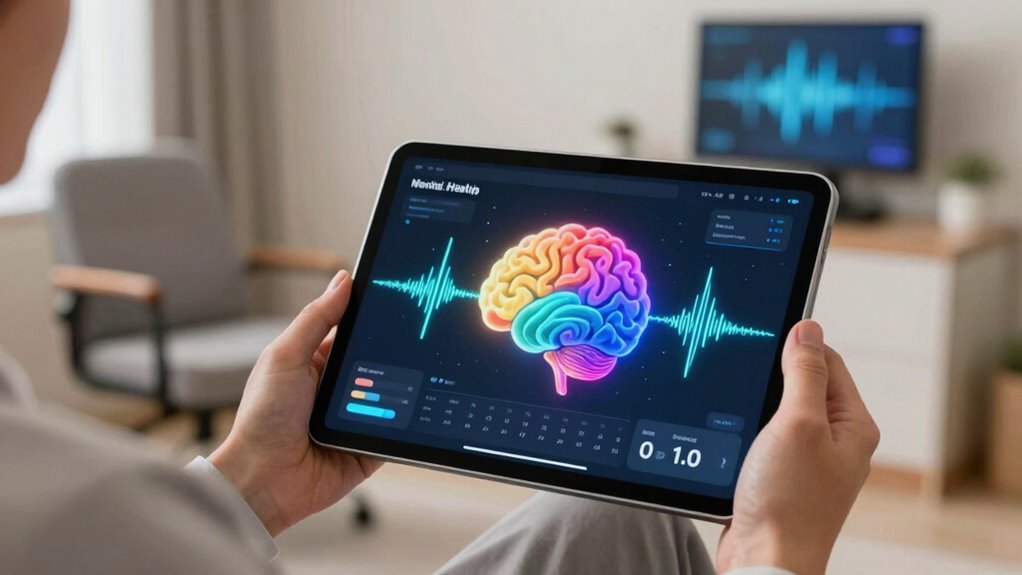
Advancements in artificial intelligence are transforming how mental health is assessed and monitored, making screenings more accessible and accurate than ever before. With AI-driven tools, you can now receive mental health evaluations that are faster, more consistent, and tailored to your individual needs. These technologies analyze vast amounts of data, including speech patterns, facial expressions, and written responses, to provide insights that might be difficult for humans to detect quickly. This scalability means more people, regardless of where they live or their access to healthcare providers, can benefit from early detection and intervention. However, as promising as these developments are, you should also be aware of some challenges that come with AI implementation.
AI is making mental health assessments faster, more accurate, and accessible for everyone, but challenges like bias and privacy remain.
One essential concern is AI bias. If the data used to train these models isn’t diverse or representative of all populations, the AI might produce biased or inaccurate assessments. For instance, if a mental health screening tool is primarily trained on data from a specific demographic, it may not perform well for others, leading to misdiagnoses or overlooked issues. This bias can inadvertently reinforce disparities in mental health care, making it essential that developers prioritize inclusive, representative datasets. As a user, you need to understand that not all AI tools are equally reliable across different groups, and ongoing efforts are needed to mitigate bias.
Data privacy is another critical aspect that influences your trust in AI-based mental health screenings. These systems often require access to sensitive personal information, including your health history, emotional states, and behavioral patterns. Without rigorous data privacy protections, this information could be vulnerable to breaches or misuse, potentially exposing you to privacy violations. It’s essential that AI developers and healthcare providers implement strong security measures and transparent data policies. As someone seeking mental health support, you should feel confident that your data is being handled ethically, with your privacy prioritized at every stage.
While AI has the potential to revolutionize mental health screening at scale, it’s important to balance innovation with caution. You should demand transparency about how these tools are trained, how they address bias, and how your data is protected. When used responsibly, AI can enhance early detection efforts and make mental health care more accessible than ever. But it’s equally important to remain vigilant, ensuring these advancements serve everyone fairly and ethically. Additionally, incorporating natural pools or environmentally sustainable solutions can support healthier communities and environments as mental health initiatives expand. Recognizing the importance of diverse training data can further improve AI accuracy and fairness in mental health assessments. Furthermore, emphasizing ethical AI practices can help build public trust and ensure these technologies are developed with societal well-being in mind. Promoting inclusive design can help ensure that AI tools are accessible and effective for all populations, reducing disparities in mental health care. Emphasizing ongoing evaluation and feedback from diverse users can help improve these systems over time.
AI mental health screening tools
As an affiliate, we earn on qualifying purchases.
As an affiliate, we earn on qualifying purchases.
Frequently Asked Questions
How Does AI Handle Cultural Differences in Mental Health Assessments?
AI handles cultural differences in mental health assessments by integrating cultural sensitivity into its algorithms and utilizing advanced language translation tools. This allows AI to better understand and interpret diverse expressions of mental health concerns across various cultures. By adapting questions and responses to specific cultural contexts, AI can provide more accurate, respectful, and personalized screenings, ultimately improving mental health support for diverse populations.
What Are Potential Biases in Ai-Driven Mental Health Screening Tools?
You should be aware that biases in AI-driven mental health screening tools can affect algorithm accuracy, leading to misdiagnoses or overlooked issues. These biases often stem from unrepresentative training data. To reduce these risks, developers focus on bias mitigation strategies, such as diversifying data sources and implementing fairness algorithms. Doing so helps guarantee assessments are more accurate and equitable, ultimately improving mental health support for all populations.
Can AI Replace Human Clinicians in Mental Health Diagnosis?
You might wonder if AI can replace human clinicians, but it’s unlikely. Despite AI’s impressive diagnostic accuracy—some systems reaching over 90%—it lacks genuine empathy necessary for mental health care. AI can support diagnosis and provide valuable insights, but human clinicians offer emotional understanding and nuanced judgment that AI can’t replicate. Your mental health needs personalized care that combines technology’s precision with human compassion.
How Is Patient Data Privacy Protected With AI Screening?
You can trust that patient data privacy is protected through robust data encryption methods that secure your sensitive information from unauthorized access. Additionally, organizations follow strict privacy policies to guarantee your data is handled ethically and transparently. These measures help maintain confidentiality during AI screening processes, giving you confidence that your personal health details are safe while benefiting from efficient, scalable mental health assessments.
What Are the Limitations of AI in Detecting Complex Mental Health Conditions?
AI struggles with detecting complex mental health conditions because it often misses emotional nuance and struggles with context interpretation. You might find that AI can identify some symptoms, but it can’t fully understand subtle emotional cues or personal circumstances that influence mental health. This limits its accuracy, especially for conditions requiring deep understanding of individual experiences. So, while helpful, AI isn’t yet a complete substitute for human expertise in complex mental health assessments.

WUCHJ Speech Therapy Notebook, Mental Health Journal for Women, Speech Pathologist Therapist Gifts Spiral Notebook Journal for Note Taking, Therapy Counselor Office Supplies, 5.5×8.3 Inch
Compact and Portable: Measures 5.5 x 8.3 inches – small enough to take anywhere, but roomy enough for…
As an affiliate, we earn on qualifying purchases.
As an affiliate, we earn on qualifying purchases.
Conclusion
Imagine using AI to spot early signs of depression through subtle language patterns in social media posts. In a recent case, an AI system flagged warning signs in user messages, prompting timely outreach and support. This shows how AI can extend mental health screening beyond traditional settings, reaching more people faster. By harnessing AI’s power, you could help save lives and provide critical care when it’s needed most—making mental health support more accessible and effective for everyone.

Emotions in Social Psychology (Key Readings in Social Psychology)
Used Book in Good Condition
As an affiliate, we earn on qualifying purchases.
As an affiliate, we earn on qualifying purchases.

The AI Life Coach for Everyday People: Finding Daily Mental Support in the Digital Age
As an affiliate, we earn on qualifying purchases.
As an affiliate, we earn on qualifying purchases.