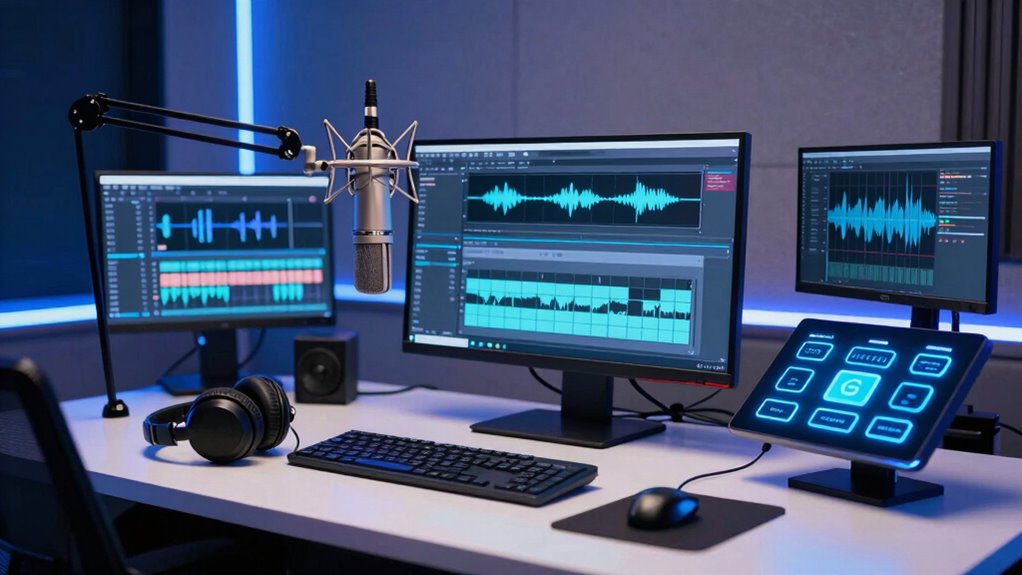

AI is transforming your podcast editing and production by automating tasks like noise reduction, voice enhancement, and transcription, making your shows sound more professional with less effort. You can improve audio quality in real-time and generate accurate transcripts instantly, which helps with content repurposing and accessibility. These tools simplify workflows, saving you time and allowing focus on creativity. As AI keeps advancing, you’ll find your production process becoming faster and simpler—stay with us to discover how these changes can benefit you.
Key Takeaways
- AI automates audio enhancement, reducing background noise and balancing levels for clearer, professional sound quality.
- Automated transcriptions enable quick content repurposing and improve accessibility.
- Advanced audio processing techniques enhance clarity, speech intelligibility, and overall listening experience.
- AI streamlines workflows by integrating editing, transcription, and quality improvements into unified platforms.
- Continued AI innovation democratizes high-quality podcast production, reducing technical barriers and increasing efficiency.

Have you ever wondered how artificial intelligence is revolutionizing podcast editing? It’s transforming the way you create content, making the process faster, more efficient, and increasingly accessible. One of the most significant changes comes through voice enhancement. With AI-powered tools, you can now automatically improve audio quality, reducing background noise, balancing levels, and clarifying voices without spending hours in post-production. This means you can focus more on your content and less on technical tweaks. These tools analyze your recordings in real-time, applying adjustments that make your voice sound clearer and more professional, even if the original recording isn’t perfect. As a podcaster, this allows you to deliver polished episodes consistently, saving time and effort. Additionally, these innovations are part of the broader requirements traceability and emerging trends in digital publishing, which continue to reshape content creation workflows.
AI-powered voice enhancement makes your recordings clearer and more professional with minimal effort.
Another groundbreaking development is automated transcriptions. Instead of manually transcribing your episodes or relying on third-party services, AI can generate accurate, real-time transcripts of your recordings. These transcriptions aren’t just helpful for accessibility; they also serve as valuable content assets. You can turn them into show notes, SEO-optimized blog posts, or social media snippets that expand your reach. The speed and precision of AI-driven transcriptions mean you get these materials almost instantly, which accelerates your production cycle and helps you stay engaged with your audience. Plus, many of these tools continuously improve their accuracy over time, learning from your specific voice and language style. This is made possible through machine learning, ensuring that the quality of transcriptions keeps improving as the system adapts to your unique speech patterns. Incorporating audio processing technology further enhances the clarity and quality of your recordings, making the final output more professional.
Furthermore, audio signal processing techniques can help in removing unwanted sounds and enhancing speech intelligibility, which is crucial for maintaining a high-quality listening experience. The combination of voice enhancement and automated transcriptions streamlines your entire workflow. Instead of juggling multiple tools or spending hours editing, you get a unified platform that handles the technical heavy lifting. This allows you to focus on the creative side—crafting engaging content, interviewing guests, and developing new ideas. AI also offers features like noise reduction, echo cancellation, and dynamic range compression, which ensure that your final product sounds professional regardless of your recording environment. This democratizes podcasting, enabling even beginners to produce high-quality episodes without expensive equipment or extensive editing skills.
In essence, AI is empowering you to produce better podcasts with less effort. It cuts down on post-production time, enhances audio quality, and provides quick access to transcripts and show notes. As these tools continue to advance, you’ll find it easier than ever to create compelling, professional-sounding content that resonates with your audience. The future of podcast editing is here, driven by AI technology that makes your production process smarter, faster, and more efficient.
As an affiliate, we earn on qualifying purchases.
Frequently Asked Questions
How Accurate Is AI in Detecting Background Noise?
AI’s accuracy in detecting background noise is quite impressive, especially when it comes to noise reduction and improving audio clarity. You’ll find that AI tools can identify and eliminate unwanted sounds with high precision, often outperforming traditional methods. While not perfect, AI continuously learns and adapts, making the noise detection process faster and more reliable, ensuring your podcast sounds professional and crisp.
Can AI Replace Human Editors Completely?
AI can’t fully replace human editors yet, especially when it comes to creative storytelling and listener engagement. While AI efficiently handles background noise removal and basic edits, it lacks the nuanced understanding needed to craft compelling narratives. Your role as an editor involves intuition and emotional insight, which are essential for engaging listeners. So, AI complements your work but doesn’t replace your expertise in shaping a enthralling podcast experience.
How Does AI Handle Sensitive or Controversial Content?
AI addresses sensitive or controversial content cautiously, constantly considering ethical considerations. It detects and diminishes bias, balancing fairness with factuality. You trust AI to handle these hurdles by honing in on harmful language, flagging potentially problematic material, and helping you maintain integrity. While AI’s automation aids in moderation, human oversight remains essential to guarantee nuanced, ethical decision-making, preventing problems before they proliferate in your podcast content.
What Are the Costs Associated With AI Podcast Editing Tools?
The costs of AI podcast editing tools vary, with some options offering subscription plans and others charging a one-time fee. When you compare costs, you’ll find that AI tools often reduce editing time, saving money in the long run. User accessibility is high, as many platforms are designed for ease of use, enabling you to quickly integrate AI into your workflow without needing extensive technical skills.
How Secure Is the Data Processed by AI Editing Platforms?
Oh, your data’s safety is totally foolproof—said no one ever. AI editing platforms claim robust security, but you should still watch out. They use encryption protocols to shield your data privacy, but no system is invincible. If you’re worried, ask about their security measures, keep backups, and avoid sharing sensitive info. Because in the digital age, trusting AI with your content is a gamble—better to be safe than sorry.
automatic audio transcription tool
As an affiliate, we earn on qualifying purchases.
As an affiliate, we earn on qualifying purchases.
Conclusion
As you embrace AI in podcast editing, it’s like having a trusty co-pilot guiding your journey. With faster edits, enhanced sound quality, and automated tasks, you’ll find your workflow smoother than ever. AI isn’t just a tool; it’s a game-changer that frees you to focus on your content and creativity. So, immerse yourself and let AI transform your podcasting experience—your audience will notice the difference.
noise reduction microphone for podcasting
As an affiliate, we earn on qualifying purchases.
As an affiliate, we earn on qualifying purchases.
As an affiliate, we earn on qualifying purchases.