
📊 Full opportunity report: Can A Marketplace Help Fill Empty Storefronts In Small Towns? on IdeaNavigator AI — validation score, market gap, and execution plan.

Get tech for your team delivered free — and shop member deals
- Fast, free delivery on millions of items
- Access to Prime Big Deal Days deals on October 6–7
- Prime Video, Amazon Music and more included
TL;DR
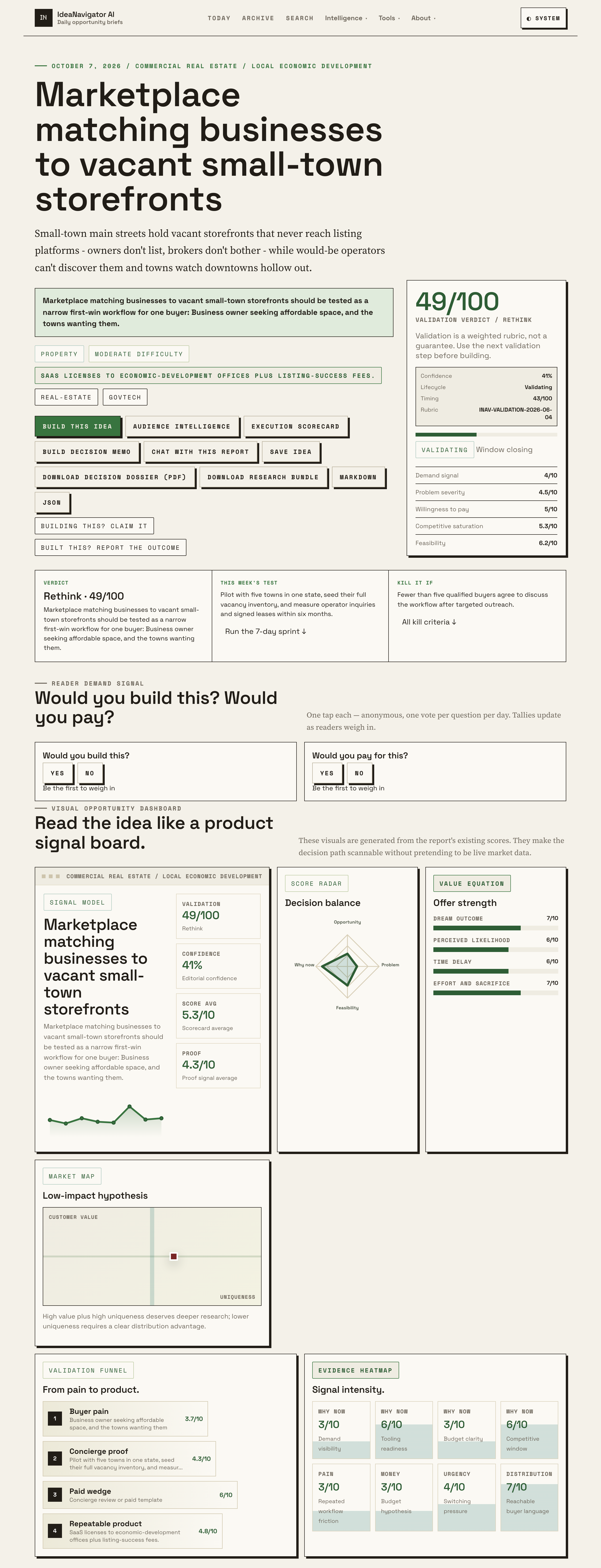
A proposal from IdeaNavigator AI outlines a marketplace to help business operators find vacant storefronts in small towns and connect with local economic-development offices. The concept has not been shown to increase leases; a proposed five-town, six-month pilot would measure inquiries and signed leases.
IdeaNavigator AI has proposed a marketplace to match business operators with vacant storefronts in small towns, routing interested operators to local economic-development offices and any available grant programs. The proposal describes a possible product and a way to test it, not a launched service or a demonstrated solution to downtown vacancies.
The proposed marketplace would let towns and property owners list storefronts with photos, floor area, rent and details of incentive programs. Operators could browse listings using information about each town and its foot traffic, then send a potential match to the local development office. The proposal says that office could provide information about grants available to the business.
The suggested customers are business owners looking for affordable commercial space and towns seeking tenants. The proposed business model combines software-as-a-service licenses sold to economic-development offices with fees tied to successful listings. No pricing, participating towns, property inventory or signed agreements are specified.
To test the idea, IdeaNavigator AI recommends a pilot involving five towns in one state. The towns would first add their full vacancy inventories, then track operator inquiries and signed leases over six months. Those are proposed measures, not reported results; no pilot launch date or evaluation data is provided.
Testing a Route to Main Street Leases
If the marketplace makes overlooked spaces easier to find, it could address a practical information gap between property owners with empty storefronts and operators seeking a place to open. Sending prospective tenants to a local development office may also make it easier to learn about grants or other town programs, rather than requiring operators to find each opportunity separately.
But a listing platform alone cannot establish whether a storefront is affordable, ready to occupy or suitable for a particular business. A pilot measuring inquiries and completed leases could show whether the matching process leads to real transactions, rather than online interest alone. For towns considering software spending, that difference matters: the proposal’s commercial model would depend on adoption by local offices and evidence of useful outcomes.
commercial storefront listing platform
As an affiliate, we earn on qualifying purchases.
As an affiliate, we earn on qualifying purchases.
The Discovery Gap Behind Vacancies
The proposal describes a specific barrier: some small-town storefront owners do not post properties to listing platforms, while brokers may not take on spaces they consider difficult to market. As a result, an operator searching for a location may not know that a suitable space is available. The proposal frames this as a visibility and coordination problem; it does not provide data on how many storefronts are affected or how often listings go undiscovered.
It also points to renewed interest in small towns linked to remote-work migration and to grant funding available through economic-development offices. These are presented as reasons the idea may be timely, but the proposal does not cite specific migration figures, grant programs or funding totals. Its suggested response is to combine property information with town-level details and a direct connection to local officials.
As an affiliate, we earn on qualifying purchases.
Pilot Results Have Not Been Reported
The available proposal does not identify participating towns, platform operators or a launch schedule. It also does not say how storefront owners would be recruited, how listings would be kept accurate, or how rent, floor area and foot-traffic information would be verified. Those details could affect whether operators trust and use the listings.
It remains unknown whether towns have grant funds available for this purpose, whether those funds can be used by businesses found through a marketplace, or what eligibility rules would apply. The concept also offers no baseline for vacancies or leasing activity, making it difficult to judge what would count as an improvement. Until a pilot reports outcomes, claims about filling storefronts should be treated as unproven.
As an affiliate, we earn on qualifying purchases.
A Five-Town Test Would Provide Evidence
The next step proposed is to select five towns in one state and enter their full inventories of vacant storefronts. A six-month test would then track operator inquiries and signed leases. To interpret those measures, participating towns would also need to explain how they define a qualified inquiry, confirm whether leases stemmed from marketplace matches and report any relevant starting vacancy or leasing figures.
No pilot has been confirmed in the information available, and there is no stated timeline for choosing towns or publishing results. Until those details emerge, the marketplace remains a testable proposal, not an established tool for reversing small-town commercial vacancies.
Source: IdeaNavigator AI
As an affiliate, we earn on qualifying purchases.
Key Questions
Has the storefront marketplace launched?
The available information presents a proposed concept. It does not confirm a launch, participating towns or a working platform.
How would the marketplace work?
Owners and towns would post storefront details, including photos, size, rent and incentives. Operators would browse listings and be connected with local economic-development offices.
How would the idea be tested?
The proposal calls for a five-town pilot in one state, with inquiries and signed leases tracked over six months. No pilot results are available.
Would the marketplace guarantee a lease or grant?
No. The proposal describes a way to connect operators with listings and local offices. It does not guarantee that a space will be leased or that an applicant will qualify for grant funding.
Source: IdeaNavigator AI
Halloween Picks
halloween
As an affiliate, we earn on qualifying purchases.