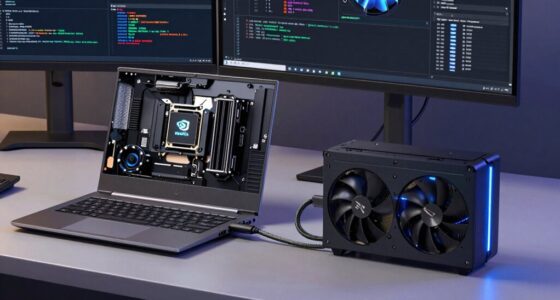
The key difference between cloud AI and edge AI is where the data is processed. Cloud AI sends data to centralized servers over the internet, offering powerful analysis but higher latency. Edge AI, on the other hand, processes data locally near the source, providing instant responses and improved privacy. Your choice depends on whether speed, privacy, or cost matters most. Keep exploring to discover how both options are shaping the future of smart technology.
Key Takeaways
- Cloud AI processes data in centralized data centers, while Edge AI analyzes data locally near the source.
- Edge AI offers lower latency for real-time decisions; cloud AI provides more powerful processing but with higher delays.
- Data privacy is enhanced with Edge AI since data stays on local devices, reducing exposure risks.
- Cloud AI typically requires less hardware investment, whereas Edge AI might need specialized hardware for local processing.
- Combining both approaches enables flexible deployment, leveraging cloud scalability and edge responsiveness.
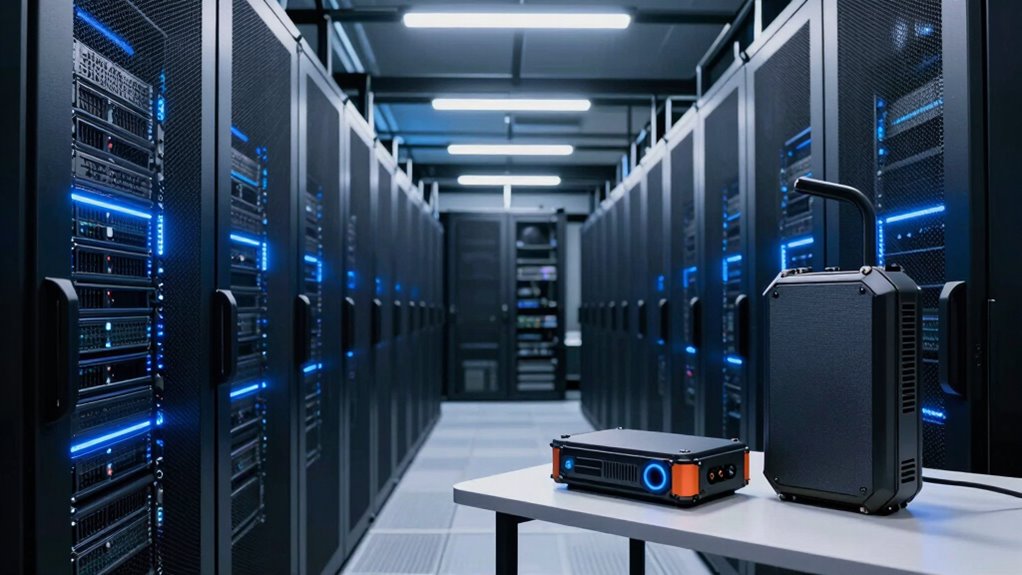
Understanding the difference between Cloud AI and Edge AI is essential as more businesses leverage artificial intelligence to enhance operations. These two approaches handle data processing and analysis differently, impacting how quickly you get results, how secure your data is, and how well your systems perform. When considering which to use, you need to think about data privacy and latency optimization, two critical factors that can influence your decision.
Cloud AI relies on centralized data centers to process information. You send your data over the internet to the cloud, where powerful servers analyze it and send back insights. This setup is ideal when you need significant processing power and want to access advanced AI tools without investing in costly hardware. However, because your data travels over networks, there’s always a risk of security breaches or data leaks, which can compromise data privacy. Plus, the time it takes for data to reach the cloud and return—latency—can be noticeable, especially if your business requires real-time responses, like in autonomous vehicles or industrial automation.
Cloud AI processes data in centralized centers, offering powerful analysis but risking security and higher latency for real-time needs.
On the other hand, Edge AI processes data locally, right where it’s generated—like on a device or nearby server. This means you can analyze data instantly, which is crucial for applications that demand instant decision-making. You don’t have to send sensitive data across the network, so data privacy is better protected, reducing exposure to potential cyber threats. Since processing occurs locally, latency is minimized, making Edge AI perfect for real-time tasks such as facial recognition or predictive maintenance on manufacturing lines. You gain speed and security, but you might need to invest in more hardware or specialized equipment to handle complex AI models at the edge. Additionally, processing capabilities at the edge are improving, enabling more complex analyses to be performed locally. As edge devices become more powerful, the gap between cloud and edge processing is narrowing, allowing for more flexible deployment options. This evolution highlights the importance of AI hardware in shaping the future of edge computing. Moreover, cloud and edge integration is becoming increasingly common, allowing organizations to optimize their AI infrastructure based on specific needs.
Furthermore, the ongoing advancements in hardware acceleration are helping to close the performance gap between cloud and edge AI, making local processing more feasible for complex tasks. Your choice depends on what matters most for your operations. If you prioritize deep analysis, scalability, and cost-efficiency, cloud AI might be the better fit. But if your focus is on rapid response times and safeguarding sensitive data, Edge AI offers significant advantages. Keep in mind, some businesses even combine both approaches—using cloud AI for extensive data analysis and Edge AI for immediate, real-time decisions. Ultimately, understanding how data privacy and latency optimization impact your workflows will help you choose the right AI architecture, ensuring your systems are both efficient and secure.

Yahboom Jetson Orin NX 8GB 117TOPS Development Kit for AI Edge Provide ROS Programming Courses Based on Core Module Ubuntu22.04 (Orin NX 8GB Basis Kit)
【Core Parameters】★AI Perf: 117/157 TOPS★GPU: 1024-core N-VI-DIA Ampere architecture GPU with 32 Tensor Cores★CPU: 8-core Arm Cortex-A78AE v8.2…
As an affiliate, we earn on qualifying purchases.
As an affiliate, we earn on qualifying purchases.
Frequently Asked Questions
How Secure Is Data in Cloud AI Versus Edge AI?
Data in cloud AI is generally well-protected through data encryption and strict security measures, but you should still be aware of privacy concerns since sensitive information is stored remotely. In contrast, edge AI processes data locally, reducing exposure to potential breaches. While it offers increased privacy, you must guarantee proper security practices on devices. Both approaches can be secure if you implement robust encryption and privacy protocols.
Which AI Approach Consumes Less Power?
Edge AI consumes less power because it processes data locally, like a firefighter tackling a blaze right at the source. Its power efficiency reduces energy consumption by avoiding constant data transmission to the cloud. This makes edge AI ideal for devices with limited power supplies, ensuring longer battery life. In contrast, cloud AI often requires more energy due to ongoing data transfer and centralized processing.
Can Edge AI Operate Independently Without Internet?
Yes, edge AI can operate independently without internet because it relies on distributed processing directly on local devices. This setup allows data to stay within your environment, enhancing data sovereignty and security. When you’re offline, edge AI continues functioning seamlessly, making real-time decisions without needing cloud connectivity. This independence is especially valuable in remote or sensitive settings, ensuring continuous operation and data control without relying on external servers.
How Do Costs Compare Between Cloud AI and Edge AI?
You might think cloud AI is cheaper, but surprise—cost comparison can favor edge AI, especially for localized tasks. Cloud AI often incurs ongoing data transfer and storage fees, while edge AI requires upfront hardware investment. Scalability factors also matter; cloud systems easily grow as your needs expand, but edge solutions can get pricey with hardware upgrades. So, it’s a balancing act, and your costs depend on your specific use case.
What Are the Best Use Cases for Each AI Type?
You should use Cloud AI for large-scale data processing, analytics, and applications that benefit from centralized resources, especially when data privacy isn’t a primary concern. It’s ideal for tasks requiring significant computational power. Edge AI works best for real-time decision-making, like autonomous vehicles or industrial automation, where reducing latency and maintaining data privacy locally are essential. Choose based on your need for speed, privacy, and processing capacity.

Personal AI Servers: A Guide to Building Private AI Infrastructure for Secure, Offline and Self-Hosted Local LLMs for Data Privacy
As an affiliate, we earn on qualifying purchases.
As an affiliate, we earn on qualifying purchases.
Conclusion
Understanding the difference between cloud AI and edge AI helps you choose the right tech for your needs. Did you know that by 2025, over 75% of enterprise data will be processed at the edge? That’s because edge AI offers faster decision-making with less latency, ideal for real-time applications. So, whether you prioritize speed or centralized power, knowing these differences guarantees you make smarter, more efficient choices for your AI solutions.

AI & Edge Computing: Practical Projects for Deploying Machine Learning Models on Raspberry Pi and Local Devices
As an affiliate, we earn on qualifying purchases.
As an affiliate, we earn on qualifying purchases.

The No-Panic Guide to AI for Seniors: Simple, Large-Print Explanations to Use ChatGPT & Gemini for Health, Travel, and Hobbies
As an affiliate, we earn on qualifying purchases.
As an affiliate, we earn on qualifying purchases.