TL;DR

Get business pricing on tech for your team
- Business-only prices and quantity discounts
- Tax-exempt purchasing
- Multiple users, one account, clear invoices
IBM and Microsoft announced Imagine Enterprise on November 10, 2026, describing it as a platform for building, running and governing AI agents in enterprise processes. IBM brings consulting expertise and more than 6,000 agents and assets, while Microsoft supplies cloud, data, security and agent tools. The companies have not disclosed pricing, a general availability date or whether customers are using it in production.
IBM and Microsoft announced Imagine Enterprise on November 10, presenting it as a platform to help large organizations build, run and govern AI agents for industry-specific processes. IBM is contributing consulting services and more than 6,000 AI agents and assets, while Microsoft is providing the cloud, data, security and agent-development technologies. The companies have not said when the platform will be generally available or disclosed its price.
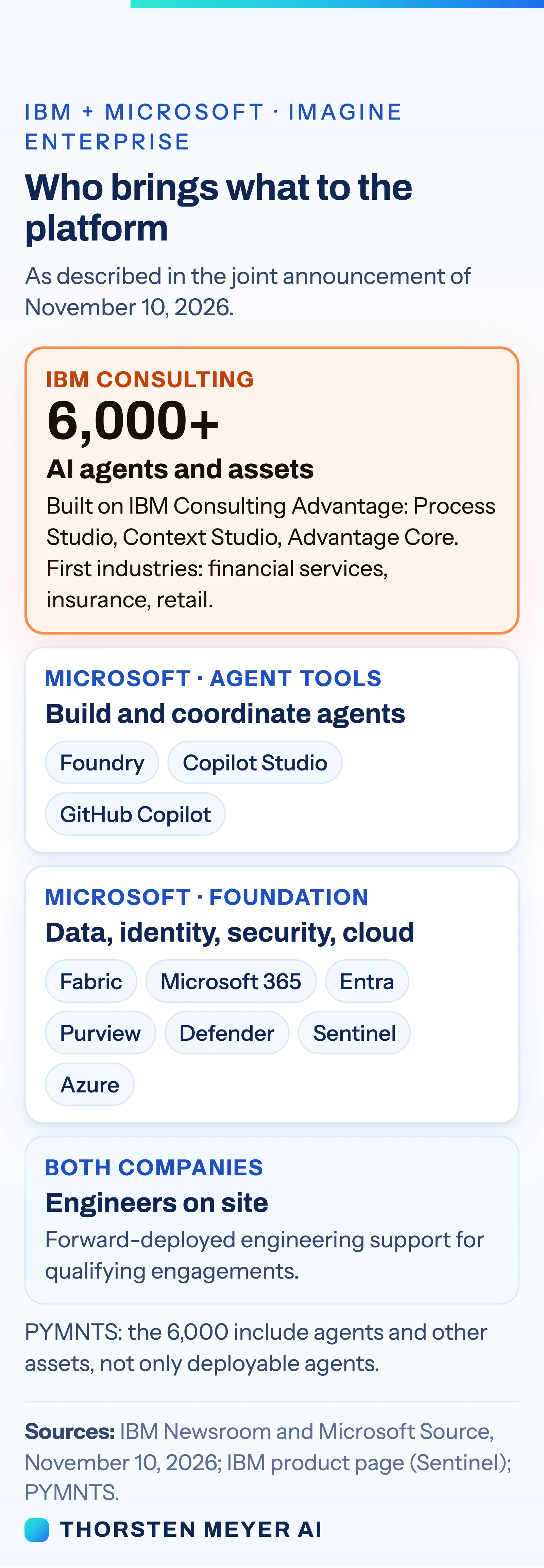
The announcement pairs IBM Consulting’s industry expertise and IBM Consulting Advantage with Microsoft products including Foundry, Copilot Studio, GitHub Copilot, Fabric, Microsoft 365, Entra, Purview, Defender and Azure. IBM’s product page also names Microsoft Sentinel as part of the security layer. The companies say the tools are intended to connect with customers’ existing data, systems and processes.
The headline figure of more than 6,000 covers “AI agents and assets,” according to the companies. PYMNTS has noted that the figure includes assets beyond agents; the announcement does not specify how many are deployable agents. IBM says customers can engage IBM Consulting to deploy and operate the platform, or work with the firm on large implementations. It also says self-management options are available, without explaining their scope.
IBM and Microsoft say engineers from both companies will provide on-site support for qualifying engagements. The announcement does not define which customers or projects qualify. IBM’s Consulting Advantage includes Process Studio, Context Studio and Advantage Core, which IBM describes as tools for designing, deploying and governing tailored agents.
A Consulting Route Into Regulated Firms
The announcement gives Microsoft’s existing agent and cloud tools a route into large organizations through IBM Consulting, which can help adapt technology to industry processes. The companies are targeting enterprises, particularly in regulated sectors, where data access, identity controls and human review can affect whether an automated system is suitable for operational work.
Financial services, insurance and retail are the industries named for the platform’s initial frameworks. If the service works as described, organizations could begin from IBM’s existing agents and assets rather than create every component themselves. That could shorten some implementation work, though the announcement gives no independent evidence about deployment speed, cost savings or business results.
The governance pitch also addresses a central practical concern: how organizations can monitor agent actions and retain human authority over decisions. IBM says customers can set which actions agents take autonomously, which need approval and which require escalation. Those are vendor descriptions, not independently verified performance findings.
Products Worth Considering

Samsung Galaxy Tab A9+ 11-Inch Android Tablet, 64GB, Graphite

Amazon Kindle Scribe (3rd Generation), 64GB, 11-inch Display, Graphite, with Premium Pen

DJI Mini 4K Drone with 4K UHD Camera
As an affiliate, we earn on qualifying purchases.
Microsoft already offers tools for developing and coordinating agents, including Foundry and Copilot Studio. Imagine Enterprise combines those products with IBM’s consulting work and industry-specific materials. The partnership therefore joins Microsoft’s technology stack with IBM’s delivery services rather than announcing a standalone model or a replacement for the named Microsoft products.
IBM describes Imagine Enterprise as a “digital talent agency for the enterprise.” In its launch materials, IBM argues that many organizations have AI pilots but have not changed how their businesses operate. The joint offer is aimed at moving from experiments toward agents used within business processes, with consultants helping customers adapt and deploy them.
IBM’s example is insurance claims handling. It describes a coordinating agent, called the “Digital Steward,” that sorts claims by complexity, checks coverage and flags possible fraud signals before routing cases to adjusters or investigators. In IBM’s account, staff retain decisions while agents support preparation and follow-up. This is an illustrative vendor example; the announcement does not identify a customer using it.
““Most organizations are running AI pilots. Almost none have fundamentally changed how the businesses operate.””
— IBM, in its launch blog
Pricing, Models and Adoption Remain Open
The companies have not announced pricing, a general availability date or supported regions. They have also not specified which AI models will run underneath the platform, how the self-management options work or what qualifies an engagement for on-site engineering support.
It is also unclear how many of the more than 6,000 listed agents and assets are agents ready for deployment. The announcement does not name a customer running Imagine Enterprise in production, and no independent evaluation of IBM’s described monitoring and governance controls was included in the source material. Those gaps make it difficult to assess the platform’s current maturity or compare its expected costs and results with other options.
Availability Details Are Still Needed
The next concrete details to watch for are a launch schedule, pricing and regional availability, alongside clearer information about model choices and the self-management offer. IBM and Microsoft may also provide more specifics on how customers qualify for engineering support and what deployment arrangements look like in practice.
Evidence from named customer deployments would help establish whether the platform is being used in production and how its controls operate under real workloads. Until the companies provide those details, the announcement sets out a proposed product and delivery model; it does not establish adoption levels or independently verified business outcomes.
Key Questions
What is Imagine Enterprise?
It is a joint IBM and Microsoft platform announced November 10, 2026, for building, running and governing AI agents in enterprise processes.
What does each company provide?
IBM brings consulting services, IBM Consulting Advantage and more than 6,000 agents and assets. Microsoft supplies products for agent development, cloud, data, identity and security.
Is the platform generally available?
The announcement does not give a general availability date or list supported regions.
Are customers using it in production?
The source material does not name a customer operating Imagine Enterprise in production. IBM’s insurance claims example is presented as a vendor illustration.
Source: Thorsten Meyer AI