

AutoML is transforming AI by automating the creation, optimization, and improvement of machine learning models with minimal human input. It handles data preprocessing, feature engineering, and model tuning automatically, making AI development faster and more accessible. This technology empowers organizations to build smarter models efficiently, even without deep expertise. If you continue exploring, you’ll discover how AutoML is shaping a future where AI designs its own solutions seamlessly.
Key Takeaways
- AutoML automates model design, training, and tuning, enabling AI systems to improve themselves with minimal human input.
- It democratizes AI development, allowing non-experts to create and deploy advanced models efficiently.
- AutoML accelerates innovation across industries by enabling rapid, scalable AI deployment and reducing reliance on specialized talent.
- Automated processes in AutoML promote continuous model evolution, optimizing AI performance over time.
- The future of AutoML includes self-adapting, explainable AI systems that further enhance AI creating AI capabilities.
Learning AutoML: Automating ML Pipelines with AutoGluon, Leading Frameworks, and Real-World Integration
As an affiliate, we earn on qualifying purchases.
As an affiliate, we earn on qualifying purchases.
Understanding AutoML and Its Core Functions

AutoML, or Automated Machine Learning, streamlines the entire process of applying machine learning to real-world problems by automating key tasks. It handles data preparation, model training, evaluation, validation, deployment, and monitoring without requiring extensive human intervention. AutoML automatically cleans and transforms raw data into usable datasets, creates new features, and selects the most relevant ones to improve model performance. It also tests multiple algorithms to find the best fit based on specific metrics like accuracy or recall. Hyperparameter tuning is automated to optimize model settings. These core functions allow users—whether data scientists or non-experts—to develop effective machine learning models faster and more efficiently. AutoML democratizes AI by making advanced techniques accessible to a broader audience. Additionally, the use of preprocessing techniques ensures that data quality and consistency are maintained throughout the modeling process. Implementing model interpretability features helps users understand how models make decisions, increasing trust and compliance. Incorporating security considerations into AutoML workflows can further enhance the robustness of deployed models against adversarial attacks and data breaches. Furthermore, integrating automated evaluation processes also helps in maintaining consistent model performance and identifying potential overfitting issues early. Moreover, integrating data augmentation methods can improve model robustness, especially when training data is limited.

Practical Automated Machine Learning on Azure: Using Azure Machine Learning to Quickly Build AI Solutions
As an affiliate, we earn on qualifying purchases.
As an affiliate, we earn on qualifying purchases.
How AutoML Democratizes Machine Learning Access

AutoML breaks down barriers that once limited machine learning to experts, making it accessible to more people. With automated processes, you don’t need deep technical knowledge to build and evaluate models. This shift empowers non-experts and organizations with limited data science resources to participate in AI development. Additionally, AutoML can incorporate ethical considerations into the model development process, helping ensure responsible AI deployment. Implementing home improvement principles such as organization and decluttering can also enhance the efficiency of data handling and model training. Recognizing the importance of contrast ratio and other image quality factors from the projector industry can inspire better data visualization and model interpretability in AI applications. Understanding Louisiana Alimony Laws helps users grasp how legal and financial factors influence AI models in related sectors. Furthermore, embracing remote collaboration tools allows diverse teams to contribute effectively regardless of geographical barriers, fostering more inclusive and innovative AI solutions.
Broadening Data Science Access
By automating complex tasks like data preprocessing, feature engineering, and model tuning, AutoML makes machine learning accessible to a broader audience. You no longer need deep expertise to build effective models; AutoML handles the technical heavy lifting, allowing you to focus on problem-solving. It simplifies data preparation, automatically cleans and transforms raw data, and identifies key features to improve model performance. With automated algorithm selection and hyperparameter tuning, you can generate high-quality models faster and more efficiently. This democratization empowers citizen data scientists, small teams, and organizations with limited resources to participate in machine learning endeavors. As a result, more people can extract insights from data, innovate, and solve real-world problems without extensive technical backgrounds. AutoML truly broadens the reach of data science. Additionally, advancements in AutoML are influenced by ongoing research into automated model selection and evaluation, which continuously enhances its effectiveness and reliability. The integration of AI in entertainment further accelerates the development of smarter, more adaptable AutoML systems, fostering innovation across various industries. Emphasizing user-friendly interfaces can help new users navigate complex AutoML tools more confidently, and incorporating explainability techniques can improve trust and transparency in automated models. Focusing on emotional support during the adoption of AutoML can help users overcome challenges and foster confidence in their new capabilities.
Empowering Non-Experts
Because AutoML automates complex tasks like data preprocessing, feature engineering, and model tuning, it enables non-experts to participate in machine learning. You no longer need deep expertise to develop reliable models; AutoML handles the technical heavy lifting. With user-friendly interfaces, you can upload data, select objectives, and let the system generate and evaluate models automatically. This opens doors for citizen data scientists, small businesses, and organizations with limited resources. You can explore data insights, improve models iteratively, and gain a better understanding of machine learning processes without extensive coding or technical training. AutoML democratizes AI by making powerful tools accessible to everyone, empowering you to solve problems, innovate, and make data-driven decisions more confidently and efficiently. Additionally, it leverages AI content clusters to organize and optimize models for specific applications, improving overall effectiveness. As the adoption of auto feature engineering grows, it further simplifies the development process and enhances model performance. Moreover, the integration of automated model selection ensures that the most suitable algorithms are chosen for each task, boosting accuracy and reliability. Furthermore, advances in model interpretability help users understand how models make decisions, increasing trust and transparency in AI solutions. By automating these complex tasks, AutoML also reduces the need for extensive manual intervention, making AI development faster and more scalable.

Practitioner’s Guide to Data Science: Streamlining Data Science Solutions using Python, Scikit-Learn, and Azure ML Service Platform (English Edition)
As an affiliate, we earn on qualifying purchases.
As an affiliate, we earn on qualifying purchases.
The End-to-End Workflow of Automated Model Development

You’ll see how AutoML streamlines data preparation by automatically cleaning and transforming raw data for model training. Then, it optimizes model performance through processes like hyperparameter tuning and algorithm selection. This end-to-end automation allows you to develop, evaluate, and deploy models faster and more efficiently. Additionally, paint sprayer technology continues to evolve with innovations that enhance precision and ease of use in various applications. Incorporating dynamic communication exercises can also improve collaboration and understanding within AI development teams, further boosting productivity. Ensuring glycolic acid products are used correctly in skincare routines is vital for maximizing their benefits and maintaining skin health. Researchers are actively working on passive voice detection techniques to improve clarity and engagement in technical documentation. Regular updates on model interpretability are essential to ensure transparency and trust in automated AI systems.
Data Preparation Automation
Data preparation automation is a crucial step in the end-to-end workflow of AutoML, streamlining the process of transforming raw data into a form suitable for modeling. You no longer need to manually clean, normalize, or encode data, as automated tools handle these tasks efficiently. AutoML systems evaluate datasets for issues like missing values, outliers, or inconsistencies, then apply preprocessing techniques automatically. They generate new features through automated feature engineering, helping models capture complex patterns. Feature selection algorithms identify the most relevant variables, reducing complexity and improving performance. This automation guarantees your data is consistently prepared for modeling, saving time and reducing errors. Ultimately, data preparation automation accelerates the entire pipeline and lays a strong foundation for accurate, reliable machine learning models.
Model Optimization Processes
Model optimization is a critical phase in AutoML’s end-to-end workflow, focusing on fine-tuning algorithms to achieve the best possible performance. During this stage, algorithms are systematically adjusted to maximize accuracy, robustness, and efficiency. AutoML automates hyperparameter tuning, model selection, and architecture search, streamlining what used to be manual, time-consuming tasks. Here’s a quick overview:
| Technique | Purpose |
|---|---|
| Hyperparameter Tuning | Finds *ideal* settings for algorithms |
| Neural Architecture Search | Automates design of deep learning models |
| Meta-Learning | Leverages past experience to improve new models |
This process *guarantees* you get the most accurate, reliable models without extensive manual intervention.
Interpretable Machine Learning with Python: Build explainable, fair, and robust high-performance models with hands-on, real-world examples
As an affiliate, we earn on qualifying purchases.
As an affiliate, we earn on qualifying purchases.
Key Techniques Powering AutoML Innovation

AutoML innovation is driven by a set of powerful techniques designed to automate and optimize various stages of the machine learning workflow. Hyperparameter optimization automatically searches for the best model settings, saving you time and improving performance. Meta-learning leverages past experiences to accelerate new model development, making it more efficient. Neural architecture search automates designing neural network structures, eliminating manual trial-and-error. These methods work together to streamline tasks like feature engineering, model selection, and tuning. By applying algorithms that learn from data and previous models, AutoML reduces reliance on expert intuition. This continuous automation allows you to develop accurate, robust models faster, while freeing you to focus on problem-solving and insights rather than tedious process steps.
Enhancing Data Preparation and Feature Engineering Automatically

AutoML automates data cleaning, transforming raw data into high-quality inputs without manual effort. It also creates new features by identifying patterns that improve model performance. This automation streamlines the entire process, making feature engineering faster and more effective.
Automated Data Cleaning
Have you ever wondered how raw, messy data gets transformed into a clean, structured format suitable for machine learning? Automated data cleaning handles this process efficiently. AutoML tools identify and correct errors, fill in missing values, and remove duplicates without manual intervention. They recognize inconsistent formats, outliers, and irrelevant data, applying appropriate transformations to standardize the dataset. This automation reduces the time and effort typically needed for preprocessing. By automatically detecting and addressing data quality issues, AutoML ensures your dataset is reliable and ready for modeling. It also adapts cleaning strategies based on data characteristics, improving overall model performance. This seamless, automated cleaning process empowers you to focus on analyzing results rather than wrestling with data issues.
Intelligent Feature Creation
Building on automated data cleaning, intelligent feature creation takes data preparation a step further by automatically generating new features that improve model performance. It identifies patterns and relationships in your data, creating meaningful variables without manual intervention. This process enhances predictive power and reduces the need for extensive domain expertise. AutoML tools analyze your dataset, engineer features like ratios, interactions, or transformations, and select the most impactful ones. This automation accelerates model development and boosts accuracy. Remember:
- It uncovers hidden relationships that manual methods might miss
- It reduces time spent on trial-and-error feature engineering
- It ensures consistently optimized features for various algorithms
Intelligent feature creation democratizes advanced data prep, making powerful models accessible even with limited technical resources.
Comparing Automl-Generated Models With Handcrafted Solutions

When comparing models generated by AutoML to handcrafted solutions, you’ll notice that automated approaches often produce competitive or even superior results in less time. AutoML leverages advanced algorithms to optimize feature selection, hyperparameters, and model architecture automatically, eliminating much of the manual trial-and-error. This efficiency means you can achieve high-performing models faster, with less expertise required. In many cases, AutoML models outperform manually crafted ones because algorithms can explore a broader space of configurations more thoroughly. Additionally, AutoML reduces human bias and oversight, leading to more objective, data-driven solutions. While handcrafted models benefit from domain expertise, AutoML’s automation accelerates development without sacrificing accuracy, making it a powerful alternative for rapid, reliable machine learning deployment.
Industry Sectors Transforming With Automl Applications
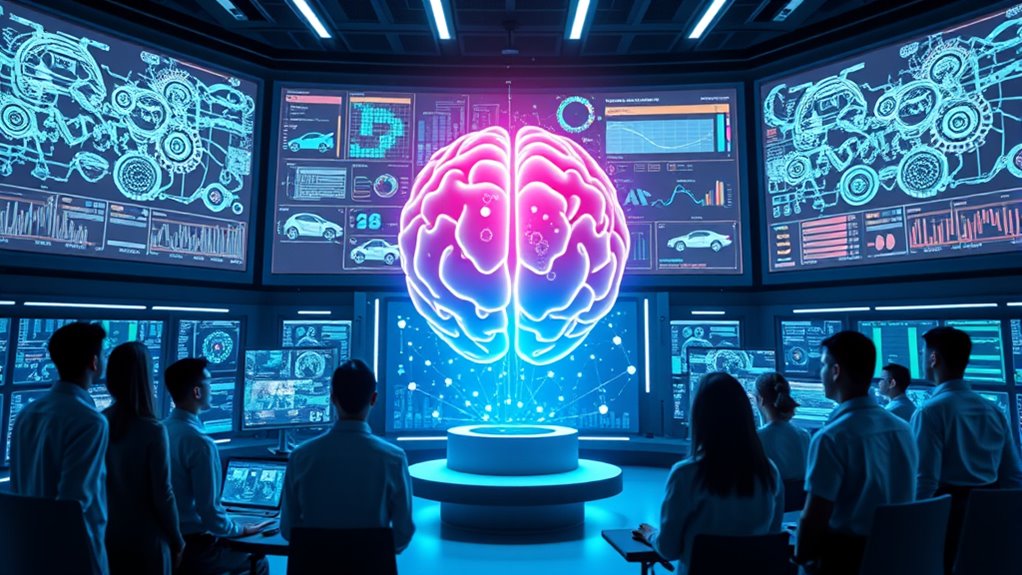
AutoML is rapidly transforming various industry sectors by enabling organizations to deploy machine learning solutions more efficiently and at scale. You can now automate complex tasks like data preprocessing, feature engineering, and model tuning, reducing reliance on specialized data scientists. This shift liberates new opportunities across sectors such as healthcare, finance, and retail, where rapid, accurate insights matter most. For example, in healthcare, AutoML accelerates diagnostics; in finance, it enhances fraud detection; and in retail, it personalizes customer experiences.
- Simplifies model development for non-experts
- Speeds up deployment and iteration
- Addresses talent shortages by broadening participation
AutoML empowers you to harness AI’s potential faster and more effectively across diverse industries.
Overcoming Talent Shortages Through Automated Machine Learning

As organizations face a growing shortage of skilled AI talent, automated machine learning offers a practical solution by streamlining complex tasks like data preprocessing, feature engineering, and model tuning. Instead of relying solely on expert data scientists, you can leverage AutoML to automate these time-consuming steps, making machine learning accessible to non-experts. This enables your team to develop high-quality models faster and with fewer specialized skills. AutoML handles model selection, hyperparameter optimization, and evaluation automatically, reducing reliance on deep technical expertise. As a result, you can scale AI deployment across your organization, improve productivity, and accelerate innovation. AutoML empowers you to overcome talent gaps, democratizing AI development and allowing more team members to contribute meaningfully to data-driven projects.
Future Trends and Opportunities in AutoML Evolution

The future of AutoML is poised for rapid evolution, driven by advancements in AI techniques and increasing demands for accessible machine learning solutions. You can expect smarter automation that adapts to new data, tasks, and industries, opening up more opportunities for non-experts. Key trends include:
- Enhanced meta-learning that accelerates model adaptation across diverse domains
- Neural architecture search becoming more efficient, enabling complex deep learning models with less human input
- Integration of explainability tools to improve transparency and trust in automated models
These developments will make AutoML more versatile, scalable, and user-friendly. As a result, organizations will increasingly leverage AutoML to democratize AI, streamline workflows, and innovate faster without extensive expertise or resources. The evolution promises a future where AI creation becomes more accessible and impactful than ever.
Challenges and Considerations for Implementing AutoML

Implementing AutoML comes with its own set of challenges that organizations must carefully navigate. One major hurdle is understanding the limitations of automated processes; AutoML tools may not always produce ideal results without human oversight. Data quality remains critical; garbage in, garbage out still applies, and automated preprocessing can’t fully replace expert judgment. Additionally, integrating AutoML into existing workflows can be complex, requiring technical adjustments and staff training. You also need to think about transparency and interpretability, as automated models can act as black boxes, making it hard to explain decisions to stakeholders. Finally, ethical concerns like bias and fairness need ongoing attention, ensuring the automated models don’t perpetuate or amplify existing issues. Balancing automation benefits with these considerations is key to successful AutoML deployment.
Frequently Asked Questions
How Does Automl Handle Data Privacy and Security Concerns?
AutoML handles data privacy and security concerns by implementing techniques like data anonymization, encryption, and secure data access protocols. You can configure AutoML systems to process data within protected environments, ensuring sensitive information stays private. Additionally, it often supports compliance standards such as GDPR or HIPAA, giving you confidence that your data remains secure throughout the automation process. This way, you focus on building models without risking data breaches or privacy violations.
Can Automl Be Customized for Industry-Specific Needs?
Yes, AutoML can be customized for industry-specific needs. You can tailor data preprocessing, feature engineering, and model selection to suit your sector’s unique requirements. By incorporating industry-specific datasets and defining relevant performance metrics, you guarantee the models align with your goals. AutoML platforms often offer configurable options, allowing you to adapt workflows, optimize for regulatory compliance, and address domain-specific challenges effectively.
What Are Automl’s Limitations With Complex or Unstructured Data?
AutoML struggles with complex or unstructured data because it often lacks the nuance needed to interpret such information effectively. You might find it challenging to get accurate results without significant manual intervention, especially with data like images, text, or audio. AutoML can automate tasks, but for intricate or unstructured data, you’ll need expert input to preprocess, feature engineer, and customize models for best performance.
How Does Automl Ensure Model Interpretability and Transparency?
Imagine 60% of organizations struggle with understanding their AI models—AutoML tackles this by emphasizing interpretability and transparency. It offers tools like feature importance and model explanations, helping you see how decisions are made. By automating the process, you gain insights into model behavior, ensuring trust and compliance. This transparency empowers you to make informed decisions, validate results, and confidently deploy models, even without deep expertise in machine learning.
What Skills Are Required for Organizations to Effectively Deploy Automl?
To deploy AutoML effectively, you need a basic understanding of data science concepts, like data preprocessing and model evaluation. You should also be comfortable with data management and have some familiarity with machine learning principles. Critical skills include problem framing, interpreting automated results, and monitoring model performance. Collaborating with data professionals helps guarantee proper implementation, while curiosity and willingness to learn are essential to adapt AutoML tools to your organization’s needs.
Conclusion
As AutoML continues to evolve, it’s clear that AI creating AI isn’t just a theory—it’s becoming a reality that democratizes machine learning. By automating complex tasks, you can open new opportunities and overcome talent shortages. Think of AutoML as your partner in innovation, making advanced analytics accessible to all. Embrace this shift now, and you’ll stay ahead in a world where automation shapes the future of AI development.