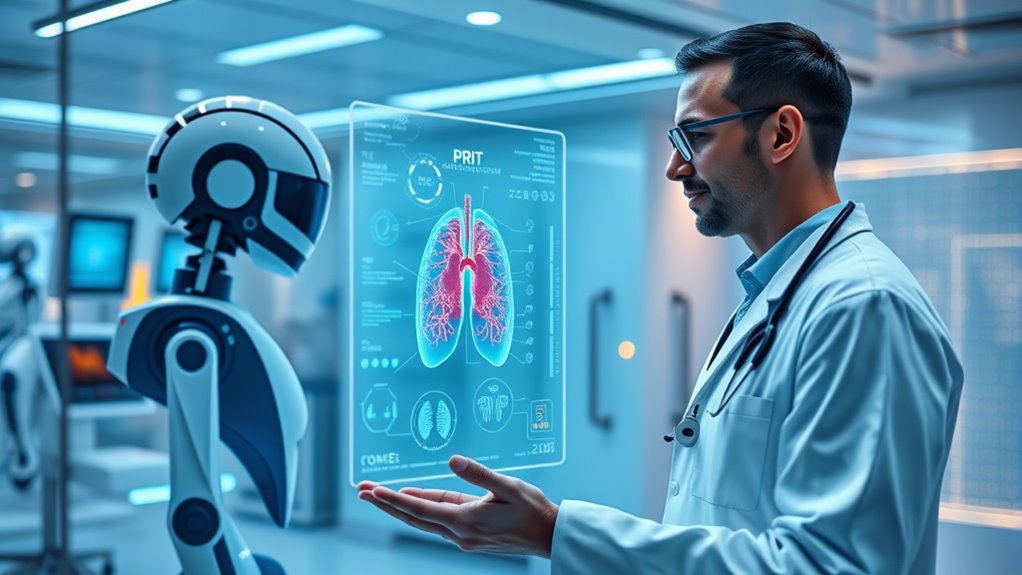

AI is revolutionizing your role by improving diagnostic accuracy, supporting faster, more personalized patient care, and streamlining workflows. It helps you identify early disease signs, manage administrative tasks, and make better decisions with advanced imaging and genetic data analysis. As AI adoption grows, you’ll see new tools that boost efficiency and promote health equity. To understand how these changes shape your profession and what’s coming next, discover more about this evolving landscape.
Key Takeaways
- AI enhances diagnostic accuracy, enabling doctors to detect diseases earlier and personalize treatment plans effectively.
- Automation of administrative tasks reduces physicians’ workload, allowing more focus on patient care.
- AI-driven tools support clinical decision-making, improving treatment outcomes and reducing diagnostic errors.
- Ethical and transparent AI integration fosters trust between doctors, patients, and healthcare organizations.
- Continuous innovation and stakeholder engagement shape a future where doctors collaborate with AI for better healthcare delivery.
AI diagnostic imaging tools for doctors
As an affiliate, we earn on qualifying purchases.
As an affiliate, we earn on qualifying purchases.
Enhancing Diagnostic Accuracy and Patient Care

How exactly is AI transforming diagnostic accuracy and patient care? You’ll notice AI tools now analyze complex medical images, often with greater precision than humans. For example, AI algorithms can detect early signs of cancer or stroke faster and more accurately, leading to earlier interventions. In radiology, AI systems identify patterns in brain scans, reducing missed diagnoses and improving treatment timing. Additionally, AI helps interpret lab results and genetic data, uncovering hidden patterns that suggest early disease risks. This integration of advanced imaging techniques supports personalized treatment plans that minimize side effects and unnecessary procedures. Moreover, the integration of high-precision imaging technology enhances the ability of AI systems to provide reliable diagnostic insights. As these technologies continue to evolve, they are also reducing diagnostic errors and streamlining workflows for healthcare professionals. Implementing noise reduction technology in medical equipment further improves image quality, aiding AI analysis and diagnosis. While AI enhances diagnostic confidence, your clinical judgment, empathy, and patient relationships remain essential, ensuring technology complements rather than replaces your expertise and human touch in delivering quality care.
medical AI software for radiology
As an affiliate, we earn on qualifying purchases.
As an affiliate, we earn on qualifying purchases.
Rapid Adoption and Integration of AI Technologies

The healthcare industry is rapidly adopting AI technologies at an unprecedented pace, transforming operational workflows and clinical practices across systems. You’ll notice major organizations deploying AI solutions widely and quickly; for example, Kaiser Permanente rolled out AI across 40 hospitals and 600+ medical offices in just over 20 years. Advocate Health evaluated hundreds of AI solutions, selecting key use cases projected to cut documentation time by over 50%. Mayo Clinic plans to invest over $1 billion in AI projects spanning diagnostics and patient care. Meanwhile, AI adoption increased sevenfold in 2024, with 22% of healthcare organizations now utilizing domain-specific AI tools. This rapid integration streamlines tasks, enhances diagnostic accuracy, and helps healthcare providers deliver more efficient, effective care in an evolving digital landscape. Additionally, the recent AI breakthrough in developing a cure for the common cold demonstrates AI’s potential to revolutionize disease treatment and medical research. The integration of AI-driven tools into clinical settings is also fostering the development of Unique and Wicked Planters, which are designed to improve indoor environments and patient recovery spaces. Incorporating AI into juice packaging and storage processes can further enhance safety and freshness in healthcare-related nutrition and wellness initiatives. As AI systems become more sophisticated, they are also increasingly capable of addressing complex data privacy challenges, which is critical given the rising concerns about AI security and safeguarding sensitive information.
AI-powered genetic data analysis tools
As an affiliate, we earn on qualifying purchases.
As an affiliate, we earn on qualifying purchases.
Addressing Workforce Challenges With AI Support

AI offers a practical solution to ongoing workforce shortages by streamlining clinical workflows and reducing administrative burdens. You can leverage AI to handle tasks like documentation, prior authorizations, and data analysis, freeing your time for direct patient care. This support helps mitigate the impact of a global shortfall of healthcare workers, especially in primary care. By integrating AI tools, you improve diagnostic accuracy, optimize treatment plans, and reduce burnout among staff. Here’s a quick overview:
| Task | AI Solution | Benefit |
|---|---|---|
| Administrative paperwork | AI-powered documentation | Saves time, reduces errors |
| Diagnostic support | Imaging and lab analysis | Enhances accuracy, speeds diagnosis |
| Patient management | AI-driven scheduling | Improves flow, reduces delays |
Additionally, medical workforce statistics can provide valuable insights into staffing trends and shortages, helping healthcare providers develop targeted strategies. This approach ensures you deliver better care despite workforce constraints. The integration of AI tools further enhances the efficiency and effectiveness of healthcare delivery. Incorporating healthcare workforce statistics can help providers better understand and address staffing challenges. Implementing AI-supported clinical workflows can further streamline patient care and optimize resource utilization. Moreover, understanding clinical workflow optimization can lead to more sustainable and efficient healthcare practices.
medical workflow automation software
As an affiliate, we earn on qualifying purchases.
As an affiliate, we earn on qualifying purchases.
Evolving Regulatory and Ethical Frameworks

As the integration of AI into healthcare accelerates, regulatory and ethical frameworks are evolving to guarantee safety, fairness, and accountability. You’ll see agencies like the FDA updating regulations to oversee the entire lifecycle of AI tools, ensuring they meet safety standards. The EU’s AI Act establishes all-encompassing rules for AI use, including healthcare applications, to prevent misuse and bias. Healthcare organizations must also prioritize training providers to recognize AI limitations and mitigate risks. Addressing algorithm bias is critical to prevent perpetuating disparities, especially for underserved populations. Data privacy remains a top concern; robust protections are essential as AI systems access sensitive patient information. Ensuring regulatory compliance is fundamental to maintaining trust and safeguarding patient rights. These evolving frameworks aim to balance innovation with safety, fostering responsible adoption of AI that benefits all patients and upholds ethical standards. Additionally, ongoing research into algorithm fairness seeks to develop methods that minimize biases and promote equitable healthcare outcomes. Recognizing the importance of model transparency, efforts are underway to make AI decision-making processes more understandable and accountable for clinicians and patients alike.
Promoting Equity and Safeguarding Data Privacy

How can healthcare guarantee that AI-driven advances benefit all populations equally while safeguarding sensitive patient data? You must prioritize equitable data collection and testing, ensuring AI tools are trained on diverse datasets to prevent bias. Implement transparent algorithms that allow clinicians to understand AI recommendations, reducing disparities caused by hidden biases. Strong data privacy measures are essential; you should use encryption, anonymization, and strict access controls to protect patient information. Regular audits and updates help maintain fairness and security. Collaboration across regions and communities ensures AI benefits reach underserved populations. Additionally, fostering inclusive data practices helps address potential disparities and promotes health equity. Recognizing the importance of creative practice and continuous innovation can also inspire new approaches to ethical AI development. Incorporating diverse datasets is crucial to reduce biases and improve AI accuracy across different demographic groups. Promoting public trust through transparency and accountability is vital for widespread acceptance of AI in healthcare. Ensuring ongoing stakeholder engagement is also key to aligning AI development with patient needs and ethical standards. By balancing innovation with ethical safeguards, you can promote health equity and build trust in AI-enabled healthcare, ensuring no one is left behind while respecting patient privacy.
Frequently Asked Questions
How Will AI Impact Doctors’ Salaries and Compensation Structures?
AI will likely influence your salary and compensation structures by increasing efficiency, reducing administrative burdens, and improving diagnostic accuracy. As a result, healthcare organizations may reward your enhanced skills with higher pay or bonuses for integrating AI tools effectively. However, some roles might see shifts in pay based on new responsibilities or specialties that emerge. Overall, AI’s impact will depend on how well you adapt and leverage these technological advancements in your practice.
What Training Will Physicians Need to Effectively Use AI Tools?
You’ll need to master new skills quickly. Expect to undergo specialized training on AI tools, learning how to interpret AI-generated insights and validate their accuracy. You’ll also need to develop a strong understanding of data privacy, ethics, and bias mitigation. Continuous education will be essential as AI evolves, ensuring you stay ahead of the technology. This knowledge will empower you to integrate AI seamlessly into your practice and enhance patient care.
How Will AI Systems Handle Rare or Complex Medical Cases?
AI systems handle rare or complex cases by analyzing vast amounts of data from similar situations, helping you identify patterns and potential diagnoses you might overlook. They provide decision support, suggesting possible options based on current evidence, but you still rely on clinical judgment and experience. As AI continues evolving, it becomes better at managing complex cases, serving as a valuable tool to enhance your decision-making without replacing your expertise.
What Measures Ensure AI Transparency and Explainability in Diagnoses?
You’ll want to focus on AI transparency and explainability because 80% of health system leaders agree regulatory oversight is essential. To guarantee this, developers incorporate clear algorithms and provide clinicians with understandable insights into AI decisions. Regular audits and validation help identify biases and errors, fostering trust. By making AI processes more transparent, you can better assess its reliability, ultimately improving patient safety and ensuring equitable, accountable diagnoses.
How Can AI Be Integrated Into Existing Healthcare Infrastructure Cost-Effectively?
To integrate AI into healthcare cost-effectively, you should prioritize scalable solutions that enhance current systems, like automating administrative tasks and supporting diagnostics. Focus on proven AI tools with clear ROI, partner with vendors for seamless integration, and utilize existing infrastructure to reduce costs. Training staff efficiently and gradually expanding AI use helps guarantee sustainable adoption without overwhelming your budget, ultimately improving care and operational efficiency.
Conclusion
Imagine AI as a trusted compass guiding you through the complex landscape of medicine. It sharpens your diagnostic accuracy, speeds up your work, and helps you serve more patients effectively. As you embrace these tools, you become part of a new era where ethical standards and data privacy are your safeguards. Just like a skilled navigator, AI empowers you to navigate challenges and advance healthcare, making the future brighter for both doctors and patients.