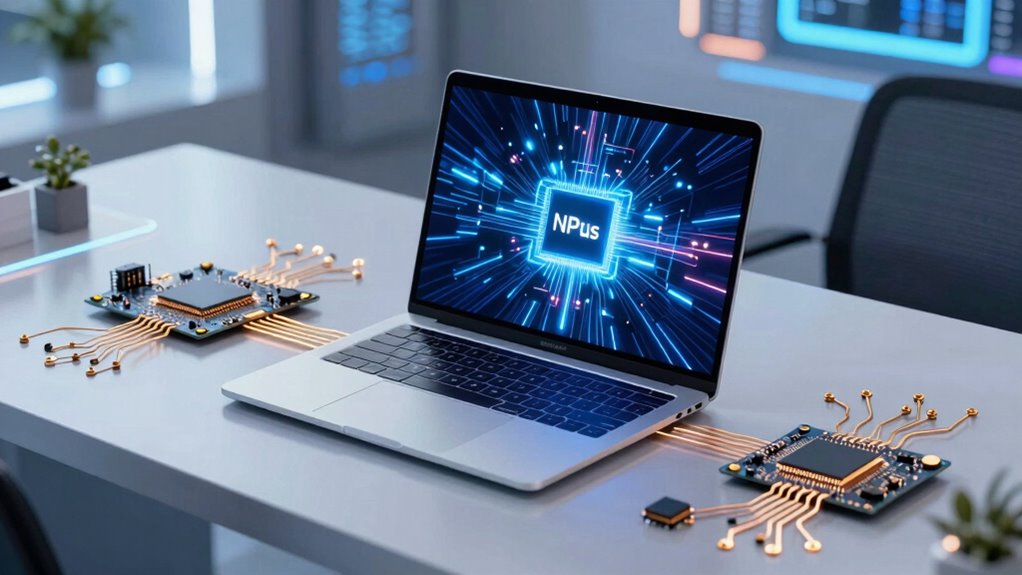

NPUs are transforming your devices by enabling local AI processing, which means faster responses, better privacy, and longer battery life. They handle complex tasks efficiently, reducing reliance on cloud servers and keeping sensitive data on your device. This leads to improved performance, smarter features, and energy savings. As NPUs become more advanced, your everyday devices will become more intelligent and personalized, offering seamless experiences. If you want to discover how this innovation shapes your tech future, keep exploring further.
Key Takeaways
- NPUs enable local AI processing, enhancing privacy and reducing reliance on cloud servers.
- They improve power efficiency, extending device battery life for sustained AI functionalities.
- Advanced NPUs support faster, real-time AI computations, boosting device performance and user experience.
- Widespread NPU adoption fosters innovative AI features in consumer devices, making them smarter and more adaptable.
- Future NPUs will drive energy-efficient, personalized, and privacy-focused consumer computing experiences.
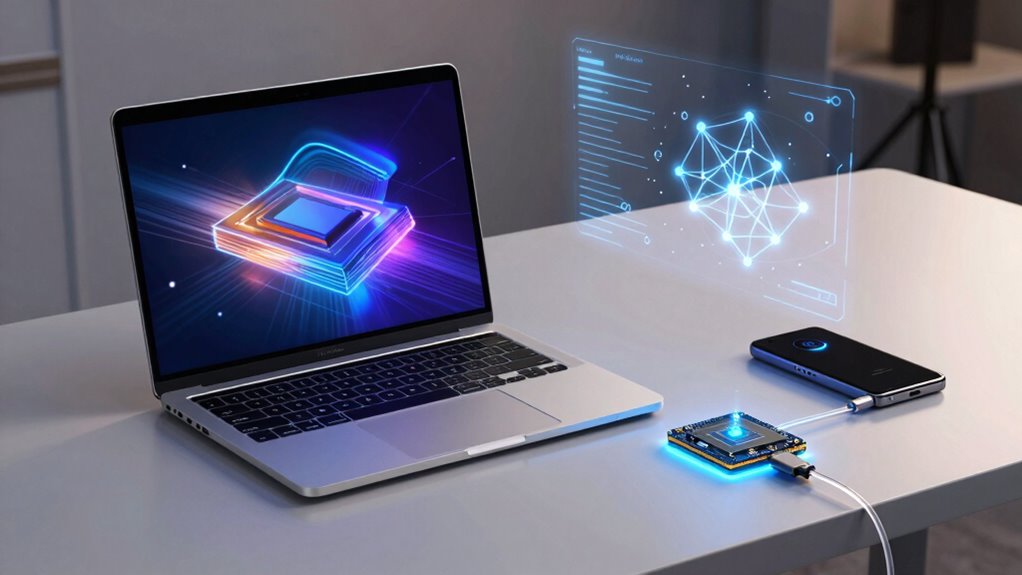
As artificial intelligence continues to evolve, Neural Processing Units (NPUs) are becoming essential components in shaping the future of consumer computing. These specialized chips are designed to handle the complex calculations that power AI applications, making your devices smarter, faster, and more responsive. One of the most significant ways NPUs are transforming your experience is through edge processing. Instead of relying solely on cloud servers, NPUs enable your devices to process data locally, right on the device itself. This shift means faster response times, reduced latency, and enhanced privacy because your sensitive information doesn’t need to travel over networks. With edge processing, your smartphone, smart home gadgets, or wearable devices can analyze data instantly, whether it’s recognizing your face, voice, or gestures, without waiting for cloud-based computations. Additionally, NPUs contribute to power efficiency in consumer devices by performing complex AI tasks with less energy, which helps prolong battery life and lowers environmental impact. Energy efficiency is another critical aspect that NPUs bring to consumer computing. Traditional processors often consume more power, which drains batteries quickly and increases energy costs. NPUs are optimized for AI tasks, allowing them to perform complex operations with much less energy. This efficiency extends your device’s battery life and reduces the environmental footprint of your tech use. When your smartphone can run advanced AI features while consuming minimal power, you enjoy longer usage without constantly reaching for the charger. Similarly, smart home devices equipped with NPUs can operate more sustainably, processing commands locally without the need for continuous internet connectivity or high energy consumption. Moreover, the development of AI acceleration hardware like NPUs is crucial in meeting the increasing demand for real-time AI applications across various consumer devices. As these chips become more sophisticated, they enable more advanced AI models to run efficiently on everyday devices, which broadens the scope of innovative applications possible for consumers. The integration of NPUs also results in faster AI processing that can handle increasingly complex tasks, further enhancing device capabilities. You also benefit from how NPUs improve overall device performance. By offloading AI workloads from the main CPU, your device runs more smoothly and efficiently. This means quicker app responses, better real-time language translation, more accurate voice assistants, and enhanced augmented reality experiences. As NPUs become more integrated into consumer devices, you’ll notice an increase in AI-driven features that are not only faster but also more reliable and context-aware. Furthermore, advancements in AI chip design continue to expand the possibilities for future consumer products, making them more adaptable and intelligent. In the future, as NPUs become more advanced and widespread, they’ll enable a new wave of smart, energy-efficient devices that prioritize your privacy and convenience. You’ll see more personalized experiences that adapt seamlessly to your habits without sacrificing performance or battery life. Ultimately, NPUs are pivotal in making consumer computing more intelligent, efficient, and user-centric—bringing the future closer with every processed byte.

The 2021 Smartphones
As an affiliate, we earn on qualifying purchases.
As an affiliate, we earn on qualifying purchases.
Frequently Asked Questions
How Do NPUS Differ From GPUS in Consumer Devices?
NPUs differ from GPUs by focusing on neural acceleration for AI processing, making them more efficient at handling specific tasks like image recognition and voice commands. While GPUs are versatile and handle graphics and parallel processing, NPUs optimize AI workloads, providing faster, power-efficient performance. In consumer devices, NPUs enhance features like camera quality and voice assistants, ensuring smoother AI functions without draining battery life.
What Are the Cost Implications of Integrating NPUS?
You might find that integrating NPUs initially increases manufacturing complexity, but it can lead to significant cost savings over time through energy efficiency and faster processing. While upfront costs are higher, the long-term benefits include reduced power consumption and improved device performance, which can lower overall costs for manufacturers and consumers. Coincidentally, this technological shift helps you enjoy smarter, more efficient devices without a hefty price tag.
Will NPUS Impact Battery Life in Smartphones?
Yes, NPUs can impact your smartphone’s battery life positively by enhancing battery optimization and power efficiency. They handle specific tasks like AI processing more efficiently than traditional CPUs, reducing overall power consumption. As a result, your device conserves energy, leading to longer usage times. So, integrating NPUs not only improves performance but also helps preserve your battery life, making your smartphone more power-efficient during everyday tasks.
How Secure Are Npu-Powered Applications?
NPU-powered applications are generally secure, but privacy concerns remain. You should know that data encryption plays an essential role in protecting your information. Developers implement encryption to safeguard sensitive data processed by NPUs, reducing risks of unauthorized access. However, always stay vigilant; guarantee apps follow best security practices and use trusted sources. By doing so, you can enjoy the benefits of NPU technology while maintaining your privacy and data security.
When Will NPUS Become Standard in All Consumer Electronics?
NPUs will become standard in all consumer electronics within the next few years, driven by rapid AI integration and market adoption. As manufacturers prioritize smarter devices, you’ll see more NPUs in smartphones, wearables, and home gadgets, enhancing performance and efficiency. This shift will make advanced AI features accessible to everyone, transforming how you interact with technology daily. Expect widespread adoption as costs decrease and demand for intelligent, responsive devices grows.

Linkind Matter Smart Plug, Work with Apple Home, Siri, Alexa, Google, SmartThings, Smart Home Smart Outlet Timer 15A/1800W, APP Remote Control & Schedule, 2.4G Wi-Fi Only, 4 Pack
【Easy Setup, One Control】With Matter, Skip the step of downloading and registering multiple manufacturers' apps every time you…
As an affiliate, we earn on qualifying purchases.
As an affiliate, we earn on qualifying purchases.
Conclusion
As NPUs continue to evolve, they’re not just shaping the future—they’re rewriting it. Imagine a world where your devices anticipate your needs before you even voice them. Isn’t it thrilling to think that the power of AI is now in your hands, transforming everyday interactions into extraordinary experiences? With NPUs leading the way, the future of consumer computing is not just near; it’s already knocking at your door, ready to change everything.

Neuromorphic Computing Applications: Brain-Inspired Chips for Edge AI Processing
As an affiliate, we earn on qualifying purchases.
As an affiliate, we earn on qualifying purchases.

Samsung Galaxy S26, Unlocked Android Smartphone, 256GB, Powerful Processor, Galaxy AI, Immersive Viewing, Durable Battery, 2026, US 1 Year Warranty, Cobalt Violet
TYPE IT IN. TRANSFORM IT FAST: Enhance any shot in seconds on your smartphone by using Photo Assist¹…
As an affiliate, we earn on qualifying purchases.
As an affiliate, we earn on qualifying purchases.